The Best Pan de Muerto with Orange Blossom Glaze
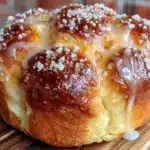
This Guest-Favorite Pan de Muerto with Orange Blossom Glaze is a soft, pillowy bread with a delicate floral aroma and a shiny, crackly glaze. Perfect for Día de Muertos gatherings, it’s a showstopper that tastes even better than it looks.
- Prep Time: 30 minutes
- Cook Time: 30 minutes
- Total Time: 3 hours 30 minutes
- Yield: 8 servings 1x
- Category: Dessert
- Cuisine: Mexican
Ingredients
Scale
- 4 cups (500g) all-purpose flour
- 1/2 cup (100g) granulated sugar
- 1 packet (2 1/4 teaspoons) active dry yeast
- 1/2 cup (120ml) whole milk, warmed to 110°F
- 4 large eggs, room temperature
- 1/2 cup (113g) unsalted butter, softened
- 1 teaspoon salt
- 1 tablespoon orange zest
- 1 teaspoon vanilla extract
- 1 teaspoon orange blossom water
- 1 1/2 cups (180g) powdered sugar
- 2 tablespoons fresh orange juice
- 1 tablespoon orange blossom water
- Pinch of salt
- Additional orange zest for decoration
- Coarse sugar or sanding sugar (optional)
Instructions
- Activate the yeast: In a small bowl, combine the warmed milk (110°F) with 1 tablespoon of the sugar and the yeast. Stir gently and let it sit for 5-7 minutes until foamy.
- Mix the dry ingredients: In the bowl of a stand mixer, whisk together the flour, remaining sugar, salt, and orange zest.
- Combine wet ingredients: In a separate bowl, whisk the eggs, vanilla extract, and orange blossom water together until smooth and slightly frothy.
- Bring it together: With the dough hook attached, add the yeast mixture and the egg mixture to the dry ingredients. Mix on low speed for about 2 minutes until a shaggy dough forms.
- Add the butter: With the mixer running on low, add the softened butter one tablespoon at a time, allowing each piece to incorporate before adding the next. Continue until the dough becomes smooth and glossy, about 8-10 minutes.
- Knead until smooth: Increase speed to medium and knead for 5-7 minutes. The dough should be soft, slightly sticky, and pass the windowpane test.
- First rise: Transfer the dough to a lightly oiled bowl, turning once to coat. Cover with plastic wrap or a damp towel. Let it rise in a warm spot for 1.5-2 hours, until doubled in size.
- Shape the dough: Punch down the dough gently. Turn it out onto a lightly floured surface. Divide into two pieces: one large piece (about 2/3) for the base, and one smaller piece (1/3) for the bone decorations.
- Form the base: Shape the large piece into a smooth round ball. Place it on a parchment-lined baking sheet, about 6 inches wide and 2 inches tall.
- Make the bones: Divide the smaller piece into 4 equal parts. Roll each into a rope about 6 inches long, then into a thinner rope about 3/8 inch thick. Cut each rope into two long pieces (about 2.5 inches) for the main bones and two shorter pieces (about 1 inch) for the knobs.
- Assemble the decorations: Place two long ropes across the top of the dough round in a cross pattern, pressing gently to adhere. Place the shorter pieces at the four points where the ropes meet the edge of the bread.
- Second rise: Cover loosely with plastic wrap and let rise again for 45-60 minutes until puffy and almost doubled.
- Preheat and egg wash: About 20 minutes before baking, preheat oven to 350°F (175°C). Whisk one egg with a tablespoon of water and gently brush over the entire surface of the bread.
- Bake: Place the baking sheet in the center of the oven. Bake for 25-30 minutes, rotating halfway through, until deep golden brown and hollow when tapped. Internal temperature should reach 190°F (88°C).
- Cool completely: Transfer the bread to a wire rack and let it cool for at least 1 hour before glazing.
- Make the glaze: In a medium bowl, whisk together the powdered sugar, fresh orange juice, orange blossom water, and salt until smooth. It should be thick but pourable.
- Glaze and decorate: Place the cooled bread on a rack over a baking sheet. Pour the glaze over the top, letting it cascade down the sides. While still wet, sprinkle with extra orange zest and coarse sugar if using.
- Let the glaze set: Allow the glaze to firm up for about 30 minutes before serving.
Notes
Temperature is key: milk should be 110°F to activate yeast. The dough is sticky; use wet hands to handle it. Rise times vary by kitchen temperature—trust the dough, not the clock. Cool bread completely before glazing to prevent a soggy crust. The bread tastes even better on day two as the orange blossom flavor mellows.
Nutrition
- Serving Size: 1/8 of the loaf with
- Calories: 380
- Sugar: 28
- Sodium: 290
- Fat: 12
- Saturated Fat: 7
- Carbohydrates: 58
- Fiber: 2
- Protein: 8
Keywords: Pan de Muerto, Day of the Dead bread, orange blossom, Mexican sweet bread, Día de Muertos, holiday bread, brioche-style bread