I was halfway through sorting a box of vintage linens at an estate sale last October when the woman running it—a retired schoolteacher named Phyllis with flour dusted on her sweater—started talking about apple cake. I hadn’t asked. I was holding a slightly stained tablecloth and thinking about lunch, but she was already describing the exact texture of the crumb, the way the cider made the kitchen smell, and how her late husband would eat three slices in one sitting. I bought the tablecloth and walked away with a recipe scribbled on the back of a receipt. Honestly, I almost lost it twice before I got home.
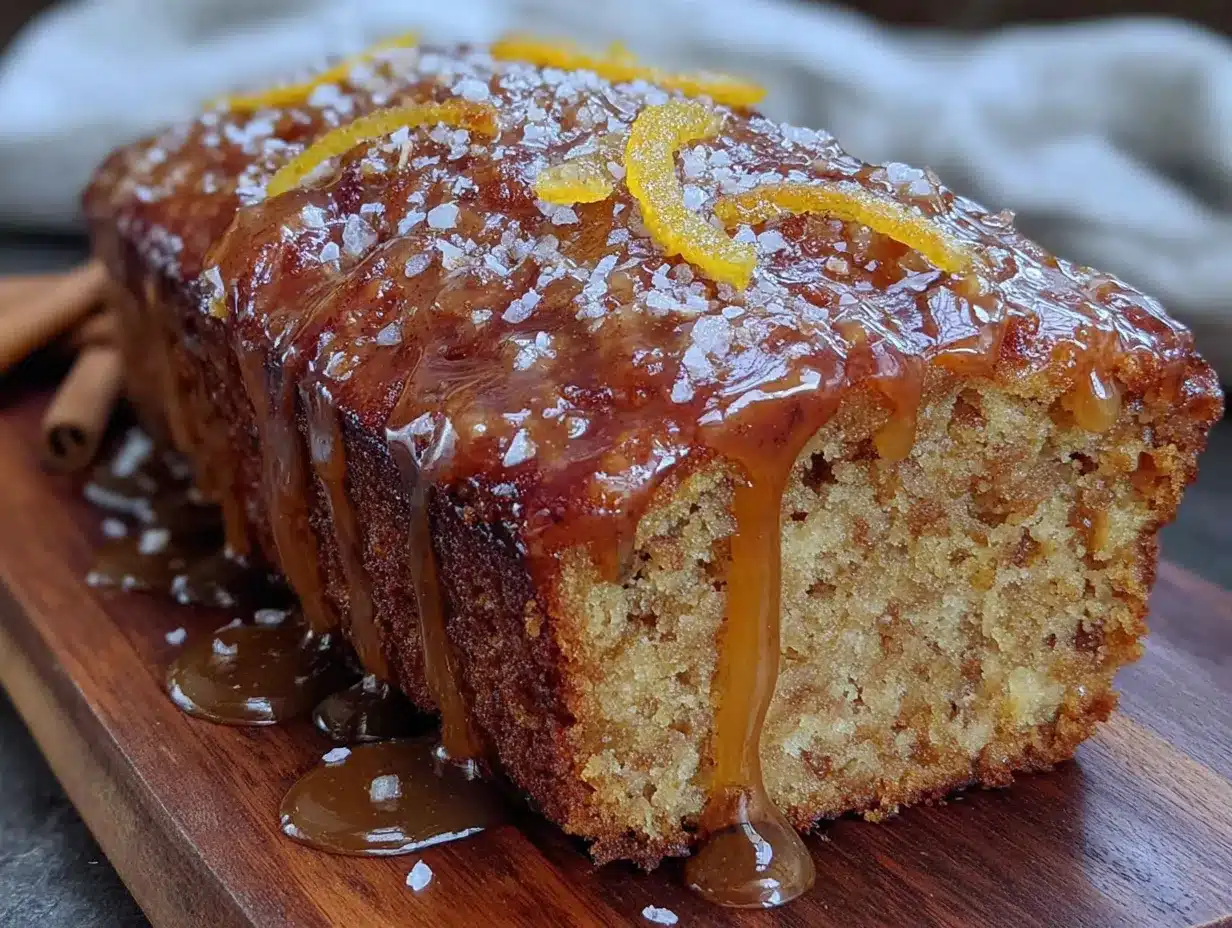
That scribbled recipe became this Cozy Apple Cider Cake with Brown Sugar Glaze, and let me tell you—it’s the kind of thing you make when the air gets that specific autumn chill and you need something warm to hold onto. The cake itself is tender and fragrant, packed with real apple cider flavor that isn’t just a hint but a full-on embrace. Then you pour that brown sugar glaze over the top, and it seeps into every crack and crevice like it knows exactly where it’s needed. The first time I made it, I forgot to set a timer and it baked about four minutes too long—still came out incredible, which says something about how forgiving this recipe is.
I mean, there are apple cakes and then there are apple cakes. This one has become my go-to for everything from Tuesday night cravings to Thanksgiving dessert when I want something less fussy than pie. The cider does this thing where it keeps the cake moist for days, if it even lasts that long. Maybe you’ve had that moment where a recipe just clicks—where you take one bite and think, this is going to be a regular thing. That’s this cake. It’s the recipe that stayed with me, the one I keep coming back to, and now I’m handing it over to you.
Why You’ll Love This Recipe
This isn’t just another apple cake recipe you’ll make once and forget. I’ve tested this version more times than I can count, tweaking the cider ratio and the glaze consistency until everything clicked. Here’s what makes it stand out:
- Quick & Easy: From mixing bowl to oven in about 15 minutes. No stand mixer required, no complicated techniques. Just a bowl, a whisk, and a little patience while it bakes.
- Simple Ingredients: You probably have most of this already—flour, sugar, butter, eggs, cinnamon. The apple cider is the star, and it’s easy to find at any grocery store this time of year.
- Perfect for Cozy Evenings: This cake was made for cold weather, rainy afternoons, and days when you need something that feels like a hug. It’s also fantastic for holiday brunches, potlucks, or just because.
- Crowd-Pleaser: I’ve brought this to three different gatherings and watched it disappear every single time. Kids love it, adults ask for the recipe, and nobody guesses how straightforward it is.
- Unbelievably Delicious: The texture is what gets me every time—tender, almost velvety, with that slight density that makes it feel substantial without being heavy. And the glaze? It’s the kind of sweet-salty-buttery situation that makes you close your eyes on the first bite.
What makes this recipe different from the dozens of other apple cakes out there is the way the cider concentrates during baking. It’s not just a flavor note—it’s the whole melody. The brown sugar glaze isn’t an afterthought either; it’s cooked briefly on the stove, which gives it a deeper, almost caramel-like richness that pairs perfectly with the warm spices. This is comfort food reimagined—simpler than you’d expect, but with the same soul-soothing satisfaction that makes you want a second slice before you’ve finished the first.
What Ingredients You Will Need
This recipe uses simple, wholesome ingredients to deliver bold apple cider flavor and that signature tender crumb. Most of these are pantry staples, which makes this cake dangerously easy to throw together on a whim.
- Apple cider, 1 ½ cups (360 ml) — Use fresh, unfiltered cider if you can find it. The cloudy kind has more flavor. I like Martinelli’s or a local orchard brand if available. Avoid apple juice—it’s too thin and sweet.
- All-purpose flour, 2 ½ cups (300 g) — Spoon and level your flour for accuracy. Scooping directly can pack it down and make the cake dry.
- Granulated sugar, 1 cup (200 g) — Regular white sugar works perfectly here. It balances the tartness of the cider.
- Light brown sugar, ½ cup (100 g), packed — This adds moisture and a subtle molasses note that plays beautifully with the apple cider.
- Unsalted butter, ½ cup (113 g), melted and slightly cooled — Melting the butter instead of creaming it keeps this recipe simple and gives the cake a denser, more tender texture.
- Large eggs, 2, room temperature — Room temperature eggs incorporate more evenly into the batter. If you forgot to take them out, place them in warm water for 5 minutes.
- Vanilla extract, 2 teaspoons — Pure vanilla makes a difference here. Imitation works in a pinch but the real stuff adds warmth.
- Baking soda, 1 teaspoon — Fresh baking soda is key. If yours has been sitting open for months, it might be weak.
- Baking powder, 1 ½ teaspoons — Double-check the expiration date. Old baking powder won’t give you the rise you want.
- Salt, ½ teaspoon — Fine sea salt or table salt. Don’t skip it—it balances the sweetness.
- Ground cinnamon, 2 teaspoons — This is the backbone spice. Use a good quality cinnamon like Saigon or Ceylon if you have it.
- Ground nutmeg, ½ teaspoon — Freshly grated is amazing, but pre-ground works fine.
- Ground ginger, ¼ teaspoon — Just a pinch for warmth. Don’t skip it—it adds depth without being obvious.
For the Brown Sugar Glaze:
- Light brown sugar, ½ cup (100 g), packed — This is the base of the glaze. Dark brown sugar works too for a deeper molasses flavor.
- Unsalted butter, ¼ cup (56 g) — Adds richness and helps the glaze set up properly.
- Heavy cream, 3 tablespoons (45 ml) — Creates that silky texture. Half-and-half works in a pinch but the glaze will be slightly thinner.
- Vanilla extract, 1 teaspoon — Adds warmth and rounds out the flavor.
- Pinch of salt — Just a tiny pinch. It makes the sweetness pop.
Equipment Needed
You don’t need a fancy kitchen to make this cake, which is honestly one of my favorite things about it. Here’s what you’ll need:
- 9-inch round cake pan — A standard metal or nonstick pan works well. Glass pans can cause the edges to brown too quickly. I use a Fat Daddio’s anodized aluminum pan and it bakes evenly every time.
- Parchment paper — Cut a circle for the bottom of the pan and grease the sides. This ensures the cake releases cleanly. Trust me on this one.
- Large mixing bowl — Any large bowl will do. I use a Pyrex glass bowl because it’s stable and easy to clean.
- Whisk — For mixing the dry ingredients and the batter. A balloon whisk works best.
- Rubber spatula — For scraping the bowl and folding in any stubborn bits of flour.
- Small saucepan — For making the glaze. A 1-quart saucepan is perfect.
- Wire cooling rack — Essential for cooling the cake evenly. If you don’t have one, let the cake cool in the pan for 10 minutes, then transfer to a plate.
- Measuring cups and spoons — For accuracy. I prefer metal measuring cups for dry ingredients and glass for liquids.
- Toothpick or cake tester — For checking doneness. A wooden skewer works too.
If you don’t have a round cake pan, an 8×8 square baking dish works beautifully—just adjust the baking time by about 5 minutes. I’ve also used a 9-inch springform pan with great results. The cake is forgiving, so don’t stress if you’re improvising.
Preparation Method
Let me walk you through this step by step. I’ve made this cake enough times to know exactly where things can go wrong, so I’ll point those out as we go.
-
Preheat your oven to 350°F (175°C). Position the rack in the center of the oven. While it’s heating, grease your 9-inch round cake pan with butter or nonstick spray, then line the bottom with a parchment paper circle. Grease the parchment too—this double insurance means your cake will come out clean every time.
-
Reduce the apple cider. Pour 1 ½ cups (360 ml) of apple cider into a small saucepan. Bring it to a boil over medium-high heat, then reduce the heat to medium-low and let it simmer for about 12-15 minutes. You want it to reduce to about ¾ cup (180 ml). It should look slightly syrupy and smell intensely of apples. Stir occasionally to prevent scorching. Set it aside to cool while you prepare the rest. Don’t skip this step—reducing the cider concentrates the flavor and removes excess liquid that would make the cake soggy.
-
Whisk dry ingredients together. In a large mixing bowl, combine 2 ½ cups (300 g) all-purpose flour, 1 teaspoon baking soda, 1 ½ teaspoons baking powder, ½ teaspoon salt, 2 teaspoons cinnamon, ½ teaspoon nutmeg, and ¼ teaspoon ginger. Whisk until everything is evenly distributed. This takes about 30 seconds. Set aside.
-
Mix the wet ingredients. In a separate medium bowl (or the same bowl if you’re a one-bowl minimalist like me), whisk together 1 cup (200 g) granulated sugar, ½ cup (100 g) packed light brown sugar, and ½ cup (113 g) melted butter until smooth. Add 2 room-temperature eggs one at a time, whisking well after each. Stir in 2 teaspoons vanilla extract. The mixture should look glossy and smell like vanilla heaven.
-
Add the reduced cider. Pour the cooled reduced cider into the wet mixture and whisk until combined. It will look a little thin at this point—that’s normal. The texture should be smooth and slightly darker than before.
-
Combine wet and dry. Pour the wet ingredients into the bowl of dry ingredients. Use a rubber spatula to fold everything together gently. Stir just until no streaks of flour remain—about 15 to 20 strokes. A few small lumps are okay. Overmixing will make the cake tough, so resist the urge to keep stirring. This is the most common mistake I made the first few times.
-
Pour into prepared pan. Scrape the batter into your prepared cake pan and spread it evenly with the spatula. The batter will be thick but pourable. Give the pan a gentle tap on the counter to release any air bubbles.
-
Bake for 35-40 minutes. Place the pan in the preheated oven and bake until a toothpick inserted in the center comes out clean or with just a few moist crumbs. The top should be golden brown and spring back when lightly touched. Start checking at 35 minutes. My oven runs hot, so I usually check at 33 minutes. If the top is browning too quickly, tent loosely with foil for the last 10 minutes.
-
Cool in the pan. Let the cake cool in the pan on a wire rack for 15 minutes. Then run a knife around the edges, invert onto the rack, remove the parchment, and let it cool completely. This usually takes about 1 hour. Don’t rush this—warm cake will make the glaze run right off.
-
Make the glaze. While the cake cools, combine ½ cup (100 g) packed light brown sugar, ¼ cup (56 g) unsalted butter, and 3 tablespoons (45 ml) heavy cream in a small saucepan. Cook over medium heat, stirring constantly, until the butter is melted and the mixture is smooth. Bring it to a gentle boil and let it bubble for 2 minutes, stirring continuously. Remove from heat, stir in 1 teaspoon vanilla and a pinch of salt. Let it cool for 5 minutes—it will thicken slightly as it sits.
-
Glaze the cake. Place the cooled cake on a serving plate or wire rack with a baking sheet underneath to catch drips. Pour the warm glaze over the center of the cake, then use a spatula to spread it gently toward the edges. Let some drip down the sides if you want that rustic look. Let the glaze set for at least 15 minutes before slicing. The anticipation is real, I know.
Cooking Tips & Techniques
I’ve made this cake more times than I can count, and I’ve learned a few things the hard way. Here’s what I wish someone had told me the first time.
Don’t skip reducing the cider. I know it’s an extra step, and I tried skipping it once. The result was a cake that was wet in the middle and took forever to bake through. Reducing concentrates the apple flavor and removes excess moisture, giving you that tender, flavorful crumb. It’s non-negotiable.
Room temperature ingredients matter. Cold eggs can seize the melted butter and create a lumpy batter. If you forgot to set them out, place them in a bowl of warm water for 5 minutes. Same goes for the cider—let it cool to room temperature before adding it to the butter mixture. Hot cider will melt the butter too much and change the texture.
Check your oven temperature. Ovens run hot or cold more often than you’d think. I keep an oven thermometer inside mine and it’s saved countless baked goods. If your cake is browning too fast on top but still raw in the middle, lower the temperature by 25°F and extend the baking time.
Let the glaze cool slightly. Pouring hot glaze on a warm cake is a recipe for a puddle. Let the cake cool completely and the glaze cool for 5 minutes before you combine them. You want the glaze to be pourable but not watery. If it gets too thick, add a teaspoon of cream and stir.
Use a serrated knife for slicing. This cake is tender, and a regular knife can squish it. A serrated knife with a gentle sawing motion gives you clean, beautiful slices. I learned this after ruining my first few pieces.
Variations & Adaptations
One of the best things about this cake is how adaptable it is. Here are some variations I’ve tried and loved:
Gluten-Free Version: Substitute the all-purpose flour with a 1:1 gluten-free baking blend that contains xanthan gum. I’ve used Bob’s Red Mill 1-to-1 with great results. The texture will be slightly more delicate, so handle the cake gently when removing it from the pan.
Dairy-Free Adaptation: Use melted coconut oil or vegan butter in place of the unsalted butter. For the glaze, substitute the heavy cream with full-fat coconut cream and use vegan butter. The flavor shifts slightly—coconut and apple is actually a lovely combination—but the texture stays remarkably similar.
Add-Ins: Fold in ½ cup of chopped walnuts or pecans after combining the wet and dry ingredients. The nuts add crunch and make the cake feel even more substantial. I’ve also added ½ cup of raisins soaked in warm cider for 10 minutes—they plump up and add little bursts of sweetness.
Spice It Up: Add ¼ teaspoon of cardamom or allspice along with the other spices. Cardamom pairs beautifully with apple and gives the cake a slightly exotic warmth that surprises people in the best way.
Apple Chunks: Dice one medium apple (Honeycrisp or Granny Smith work well) and fold it into the batter before baking. The apple pieces soften during baking and add little pockets of fruit. Toss them in a tablespoon of flour first to prevent them from sinking to the bottom.
Bundt Pan Version: Grease a 10-cup bundt pan thoroughly and pour in the batter. Bake at 350°F for 45-50 minutes. The glaze can be poured over the top or served on the side. This version looks stunning for company.
Serving & Storage Suggestions
This cake is at its best served slightly warm with a cup of coffee or a glass of cold milk. The glaze is soft and glossy, and the cake itself is tender enough that it almost melts on your tongue.
For presentation, I like to place the cake on a simple white cake stand and let the glaze drip naturally. A dusting of cinnamon on top adds a nice visual touch. If you’re feeling fancy, add a dollop of lightly sweetened whipped cream or a scoop of vanilla ice cream on the side. The contrast between warm cake and cold cream is absolutely divine.
This cake pairs beautifully with hot apple cider, chai tea, or a dark roast coffee. For a dessert spread, serve it alongside a simple vanilla panna cotta or a cheese plate with sharp cheddar and sliced apples.
Storage: Store the cake in an airtight container at room temperature for up to 3 days. The glaze will soften slightly over time, but the flavor actually improves after a day—the spices meld together beautifully. If you live in a humid climate, refrigerate the cake to prevent the glaze from becoming sticky.
Freezing: You can freeze the unglazed cake for up to 3 months. Wrap it tightly in plastic wrap, then in foil. Thaw overnight in the refrigerator, bring to room temperature, then make the glaze fresh and pour it over. I’ve done this for holiday prep and it works like a charm.
Reheating: To recapture that fresh-from-the-oven warmth, microwave individual slices for 15-20 seconds. For a whole cake, warm it in a 300°F oven for 10 minutes. The glaze will soften and become glossy again.
Nutritional Information & Benefits
Per slice (based on 10 servings, with glaze): approximately 380 calories, 16g fat, 56g carbohydrates, 4g protein, 2g fiber, 32g sugar. These values are estimates and will vary based on specific ingredients and substitutions.
While this is definitely a treat, there are some redeeming qualities worth mentioning. Apple cider contains antioxidants called polyphenols, which may help reduce inflammation. Cinnamon has been shown to help regulate blood sugar levels, and the eggs provide a good source of protein and choline. The brown sugar glaze is indulgent, but a smaller drizzle still delivers plenty of flavor.
For those watching their sugar intake, you can reduce the granulated sugar to ¾ cup without significantly affecting the texture. The glaze can also be made with a sugar substitute, though the texture will be slightly different. This cake is naturally nut-free and can be made dairy-free and gluten-free with the substitutions listed above. It contains eggs and wheat in its standard form.
My personal philosophy is that food like this isn’t about nutrition—it’s about nourishment of a different kind. Sometimes you need a slice of cake that makes you feel warm and cared for, and that has its own kind of value.
Conclusion
This Cozy Apple Cider Cake with Brown Sugar Glaze is the kind of recipe that becomes a tradition. It’s simple enough for a Tuesday night, special enough for a holiday table, and forgiving enough that even if you forget to set the timer (like I did the first time), it still turns out beautifully. The reduced cider gives it a depth of flavor that surprises everyone who tries it, and that brown sugar glaze is the kind of thing you’ll want to put on everything.
I love this cake because it reminds me of that unexpected conversation with Phyllis, of finding something wonderful in a place I wasn’t looking. It’s proof that the best recipes often come from the most unlikely sources. I hope you’ll make it your own—add your favorite nuts, experiment with the spices, or just follow it exactly as written. Either way, I think you’ll find yourself coming back to it again and again.
If you make this cake, I’d love to hear about it. Leave a comment below, tag me in your photos, or tell me what variation you tried. And if you have your own unexpected recipe story, I’m all ears. Happy baking, friend.
Frequently Asked Questions
Can I use apple juice instead of apple cider?
I wouldn’t recommend it. Apple juice is thinner and sweeter, with less of that tart, complex flavor that makes this cake special. The reduced cider is what gives the cake its deep apple taste. If you’re in a pinch, use apple cider from the refrigerated section of the grocery store—it’s usually unfiltered and has more flavor.
Can I make this cake ahead of time?
Absolutely. The cake actually tastes better the next day as the flavors meld together. Bake the cake, cool it completely, and store it wrapped tightly at room temperature. Make the glaze fresh the day you plan to serve it. The glaze takes about 10 minutes, so it’s easy to do right before serving.
Why did my cake sink in the middle?
This usually happens for one of three reasons: the oven door was opened too early (wait until at least 30 minutes), the cake was underbaked (check with a toothpick), or the baking soda/powder is old. Make sure your leaveners are fresh and resist the urge to peek during the first 30 minutes of baking.
Can I double this recipe?
Yes! Double all ingredients and bake in a 9×13-inch pan for about 40-45 minutes, or until a toothpick comes out clean. The glaze recipe can also be doubled. This is my go-to for potlucks and holiday gatherings—it travels well and serves a crowd.
How do I get clean slices without the glaze smearing?
Let the glaze set for at least 15 minutes before slicing. Use a sharp serrated knife and wipe the blade clean between each cut. For the cleanest slices, you can even refrigerate the glazed cake for 20 minutes before cutting—the glaze firms up and cuts much more cleanly.
Pin This Recipe!
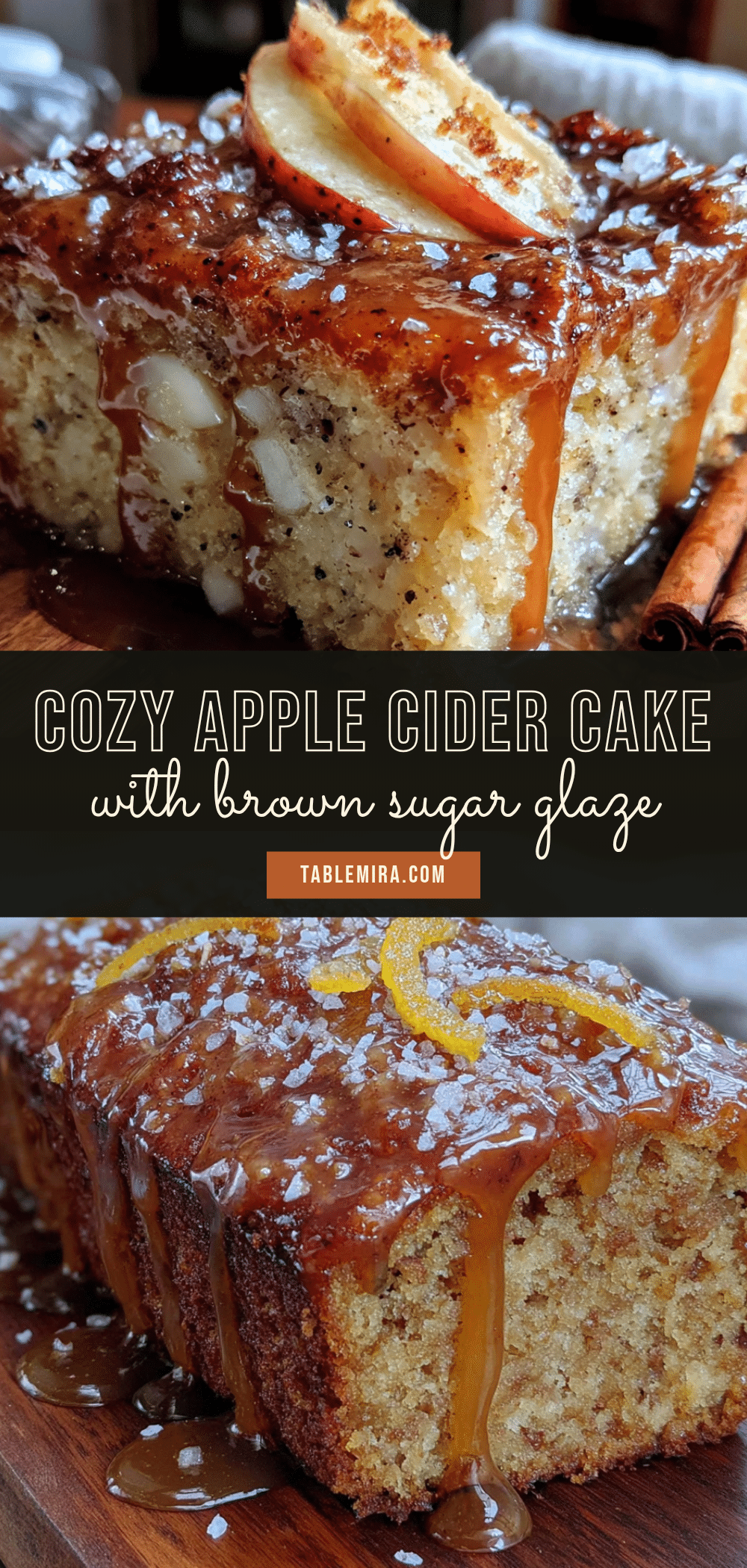
Cozy Apple Cider Cake with Brown Sugar Glaze: Easy Fall Dessert
A tender, fragrant apple cider cake with a rich brown sugar glaze that seeps into every crevice. Perfect for cozy evenings, holiday brunches, or any time you need a warm, comforting dessert.
- Prep Time: 15 minutes
- Cook Time: 35-40 minutes
- Total Time: 1 hour 15 minutes (including cooling)
- Yield: 10 servings 1x
- Category: Dessert
- Cuisine: American
Ingredients
- 1 ½ cups (360 ml) apple cider
- 2 ½ cups (300 g) all-purpose flour
- 1 cup (200 g) granulated sugar
- ½ cup (100 g) light brown sugar, packed
- ½ cup (113 g) unsalted butter, melted and slightly cooled
- 2 large eggs, room temperature
- 2 teaspoons vanilla extract
- 1 teaspoon baking soda
- 1 ½ teaspoons baking powder
- ½ teaspoon salt
- 2 teaspoons ground cinnamon
- ½ teaspoon ground nutmeg
- ¼ teaspoon ground ginger
- For the Brown Sugar Glaze:
- ½ cup (100 g) light brown sugar, packed
- ¼ cup (56 g) unsalted butter
- 3 tablespoons (45 ml) heavy cream
- 1 teaspoon vanilla extract
- Pinch of salt
Instructions
- Preheat your oven to 350°F (175°C). Grease a 9-inch round cake pan with butter or nonstick spray, then line the bottom with a parchment paper circle. Grease the parchment too.
- Reduce the apple cider: Pour 1 ½ cups (360 ml) of apple cider into a small saucepan. Bring to a boil over medium-high heat, then reduce heat to medium-low and simmer for about 12-15 minutes until reduced to about ¾ cup (180 ml). Set aside to cool.
- Whisk dry ingredients together: In a large mixing bowl, combine 2 ½ cups (300 g) all-purpose flour, 1 teaspoon baking soda, 1 ½ teaspoons baking powder, ½ teaspoon salt, 2 teaspoons cinnamon, ½ teaspoon nutmeg, and ¼ teaspoon ginger. Whisk until evenly distributed.
- Mix the wet ingredients: In a separate medium bowl, whisk together 1 cup (200 g) granulated sugar, ½ cup (100 g) packed light brown sugar, and ½ cup (113 g) melted butter until smooth. Add 2 room-temperature eggs one at a time, whisking well after each. Stir in 2 teaspoons vanilla extract.
- Add the reduced cider: Pour the cooled reduced cider into the wet mixture and whisk until combined.
- Combine wet and dry: Pour the wet ingredients into the bowl of dry ingredients. Use a rubber spatula to fold together gently until no streaks of flour remain. Do not overmix.
- Pour into prepared pan: Scrape the batter into the prepared cake pan and spread evenly. Give the pan a gentle tap on the counter to release air bubbles.
- Bake for 35-40 minutes, until a toothpick inserted in the center comes out clean or with a few moist crumbs. If the top browns too quickly, tent loosely with foil for the last 10 minutes.
- Cool in the pan on a wire rack for 15 minutes. Then run a knife around the edges, invert onto the rack, remove the parchment, and let cool completely (about 1 hour).
- Make the glaze: In a small saucepan, combine ½ cup (100 g) packed light brown sugar, ¼ cup (56 g) unsalted butter, and 3 tablespoons (45 ml) heavy cream. Cook over medium heat, stirring constantly, until butter is melted and mixture is smooth. Bring to a gentle boil and let bubble for 2 minutes, stirring continuously. Remove from heat, stir in 1 teaspoon vanilla and a pinch of salt. Let cool for 5 minutes.
- Glaze the cake: Place the cooled cake on a serving plate or wire rack with a baking sheet underneath. Pour the warm glaze over the center, then spread gently toward the edges. Let set for at least 15 minutes before slicing.
Notes
Don’t skip reducing the cider—it concentrates flavor and removes excess moisture. Room temperature ingredients matter for even mixing. Let the cake cool completely before glazing to prevent the glaze from running off. Use a serrated knife for clean slices.
Nutrition
- Serving Size: 1 slice
- Calories: 380
- Sugar: 32
- Sodium: 280
- Fat: 16
- Saturated Fat: 10
- Carbohydrates: 56
- Fiber: 2
- Protein: 4
Keywords: apple cider cake, brown sugar glaze, fall dessert, easy apple cake, cozy cake, apple cake recipe