“The potluck was in three hours and I’d completely forgotten.” That was the text I sent my friend Jenna on a particularly chaotic Tuesday in November. Everyone else would be bringing their signature dishes—Jenna’s legendary seven-layer dip, Mark’s slow-cooked brisket that he’d probably started marinating the night before. I had a half-empty carton of milk, some sad-looking cheddar, and a butternut squash that was meant for a soup I’d never gotten around to making. Honestly, I almost just grabbed a bag of chips from the pantry. But then I remembered this weird recipe I’d seen floating around—mac and cheese with squash blended into the sauce. It sounded kind of crazy, but I was desperate. I roasted the squash in a panic, burned my finger on the baking sheet, and spilled milk on the stovetop. Let me tell you, when I walked into that potluck with my slightly lopsided baking dish, I felt like a fraud. Everyone else had these beautiful, elaborate dishes. And then people started tasting mine. The dish was empty in twenty minutes. Jenna asked for the recipe. Mark asked if I’d cater his holiday party. I just stood there, sheepish, holding my empty dish and a very smug-looking spatula. That’s the thing about this Easy Roasted Butternut Squash Mac and Cheese—it doesn’t look like a showstopper, but it absolutely tastes like one. It’s creamy, it’s cozy, and it’s the kind of dish that makes you feel like you’ve got it all figured out, even when you definitely don’t.
Why You’ll Love This Recipe
Let’s be real for a second—there are a million mac and cheese recipes out there. So what makes this one different? Why should you trust me, the person who showed up to a potluck empty-handed and panicking?
First off, I’ve tested this recipe more times than I care to admit. The first version was too watery. The second was too gritty (I didn’t roast the squash long enough). The third? That was the one. I’ve tweaked it based on feedback from everyone from my picky-eater nephew to my nutritionist friend, and I can confidently say this version is foolproof.
- Quick & Easy: This comes together in about 45 minutes, and most of that is hands-off roasting time. Perfect for a weeknight when you need something warm and comforting without spending hours in the kitchen.
- Simple Ingredients: No fancy grocery trips needed. You probably have most of this in your kitchen right now. The squash is the star, and it’s easy to find in any grocery store.
- Perfect for Cozy Nights: This is the ultimate comfort food for cold weather, a rough day, or just a quiet evening when you need a hug in a bowl.
- Crowd-Pleaser: I’ve served this to kids, adults, and even a few self-proclaimed “squash haters.” It disappears every single time. The squash blends in so smoothly that even the pickiest eaters won’t notice it’s there.
- Unbelievably Delicious: The texture is next-level—creamy, velvety, and rich without being heavy. The roasted squash adds a natural sweetness that pairs perfectly with the sharp cheddar. It’s comfort food reimagined.
This recipe isn’t just good—it’s the kind that makes you close your eyes after the first bite. It’s the dish you’ll make when you want to impress someone without any stress, or when you just need a quiet moment of pure, soul-soothing satisfaction.
What Ingredients You Will Need
This recipe uses simple, wholesome ingredients to deliver bold flavor and that signature creamy texture. Most of these are pantry staples, and the squash does all the heavy lifting in terms of flavor and creaminess.
For the Roasted Butternut Squash
- 1 medium butternut squash (about 2-3 pounds), peeled, seeded, and cubed into 1-inch pieces (look for a squash that feels heavy for its size and has a firm, unblemished skin)
- 2 tablespoons olive oil (I prefer extra virgin for roasting, but any neutral oil works)
- 1/2 teaspoon salt (fine sea salt or kosher salt—both work great)
- 1/4 teaspoon black pepper (freshly ground is best, but pre-ground is fine)
- 1/4 teaspoon garlic powder (optional, but it adds a lovely savory note)
For the Pasta and Cheese Sauce
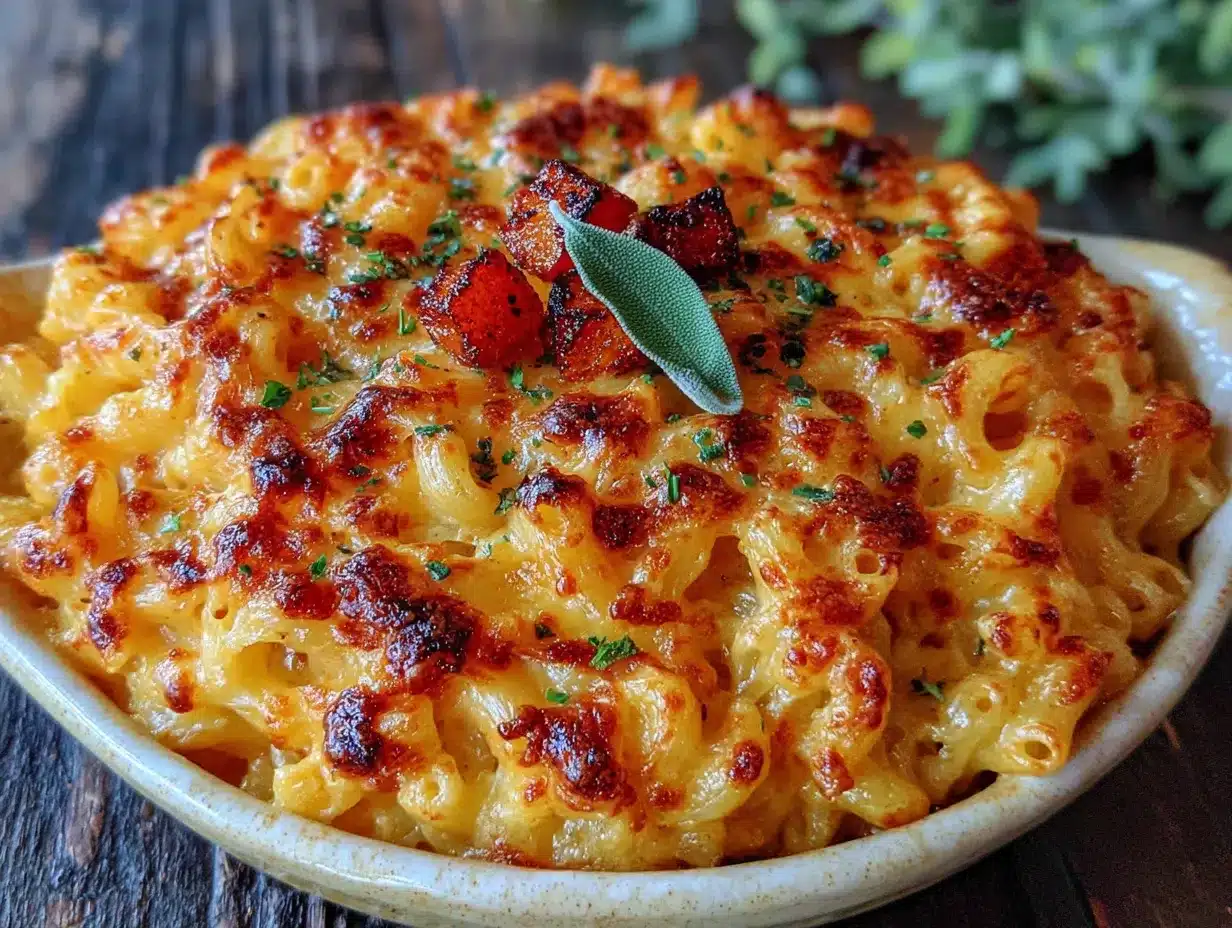
- 1 pound (16 ounces) elbow macaroni (or any short pasta like cavatappi, shells, or rotini—I personally love cavatappi because the ridges hold the sauce so well)
- 4 tablespoons (1/2 stick) unsalted butter (adds richness; you can use salted butter, just reduce the added salt slightly)
- 1/4 cup all-purpose flour (for thickening the sauce; use a gluten-free all-purpose blend if needed)
- 3 cups whole milk (for the creamiest sauce; 2% works too, but avoid skim milk)
- 1 cup heavy cream (optional, but it takes the richness over the top; you can substitute with an additional cup of milk)
- 2 cups shredded sharp cheddar cheese (I recommend block cheese shredded at home—it melts so much smoother than pre-shredded, which has anti-caking agents)
- 1 cup shredded Gruyère or fontina cheese (optional, but it adds incredible nuttiness and meltability; use extra cheddar if you want to keep it simple)
- 1/2 cup grated Parmesan cheese (freshly grated is a game-changer here)
- 1 teaspoon Dijon mustard (trust me on this—it doesn’t make it taste like mustard, it just enhances the cheesy flavor)
- 1/2 teaspoon smoked paprika (adds a subtle warmth and depth)
- 1/4 teaspoon nutmeg (freshly grated if you have it—it’s magical with the squash)
- Salt and pepper to taste
For the Topping (Optional but Highly Recommended)
- 1/2 cup panko breadcrumbs (regular or gluten-free)
- 2 tablespoons unsalted butter, melted
- 1/4 cup grated Parmesan cheese
- 1 tablespoon fresh thyme or sage leaves (optional, for a fragrant, earthy finish)
Equipment Needed
You don’t need a professional kitchen to make this, but having the right tools makes the process smoother and more enjoyable.
- Baking sheet: A rimmed baking sheet is ideal for roasting the squash without spilling any juices. I’ve used a cheap one for years and it works perfectly.
- Large pot: For boiling the pasta. A 6-quart pot is a good size.
- Medium saucepan: For making the cheese sauce. A heavy-bottomed saucepan prevents scorching.
- Blender or food processor: To puree the roasted squash into a silky smooth consistency. An immersion blender works in a pinch, but a countertop blender gives the smoothest results.
- Whisk: Essential for a lump-free sauce. A silicone-coated whisk is gentle on non-stick pans.
- 9×13-inch baking dish: For assembling and baking the mac and cheese. A glass or ceramic dish works best for even heat distribution.
- Cheese grater: Please, for the love of all things cheesy, grate your own cheese. A box grater is inexpensive and makes all the difference.
- Measuring cups and spoons: For accuracy. Baking is a science, and cooking this recipe benefits from precision.
If you don’t have a blender, you can mash the roasted squash with a fork or potato masher, but the texture won’t be as silky. Trust me, the blender is worth the extra dish.
Preparation Method
Let’s get cooking! This recipe has a few components, but I’ve broken it down into simple, manageable steps. Take your time, and don’t rush the roasting—it’s the secret to the deep, sweet flavor.
Step 1: Roast the Butternut Squash
- Preheat your oven to 400°F (200°C). Line a rimmed baking sheet with parchment paper for easy cleanup.
- Place the cubed butternut squash on the prepared baking sheet. Drizzle with the olive oil, then sprinkle with salt, pepper, and garlic powder if using. Toss everything together with your hands until the squash is evenly coated. Spread it out in a single layer—crowding the pan will steam the squash instead of roasting it.
- Roast for 25-30 minutes, flipping the pieces halfway through, until the squash is tender and caramelized around the edges. You should be able to easily pierce a piece with a fork. The natural sugars will concentrate, giving you that sweet, nutty flavor.
- Remove from the oven and let cool slightly. Transfer the roasted squash to a blender or food processor. Add about 1/4 cup of water or milk and blend until completely smooth. You’re looking for a consistency similar to pumpkin puree. Set aside.
Step 2: Cook the Pasta
- While the squash is roasting, bring a large pot of salted water to a rolling boil. Use about 1 tablespoon of salt per 4 quarts of water—it seasons the pasta from the inside out.
- Add the elbow macaroni and cook according to package directions until al dente. For most brands, that’s about 7-8 minutes. Be careful not to overcook, because the pasta will continue to cook slightly when baked.
- Drain the pasta in a colander, but do not rinse it. Rinsing removes the starch that helps the sauce cling to the noodles. Just let it drain well and set it aside.
Step 3: Make the Cheese Sauce
- In a medium saucepan, melt the butter over medium heat. Once it’s bubbling, whisk in the flour. Cook for about 1 minute, whisking constantly, until the mixture is golden and smells slightly nutty. This is your roux, and it’s the foundation of a smooth sauce.
- Slowly pour in the milk and heavy cream (if using), whisking continuously to prevent lumps. Keep whisking until the mixture is smooth and starts to thicken, about 3-5 minutes. It should coat the back of a spoon.
- Reduce the heat to low. Add the Dijon mustard, smoked paprika, and nutmeg. Whisk to combine.
- Gradually add the shredded cheddar, Gruyère (if using), and Parmesan cheese, a handful at a time, stirring until each addition is completely melted before adding the next. This ensures a silky, lump-free sauce.
- Stir in the butternut squash puree until fully incorporated. The sauce will turn a beautiful golden-orange color. Taste and adjust seasoning with salt and pepper. Remember, the cheese is salty, so go easy on the salt at first.
Step 4: Assemble and Bake
- Preheat your oven to 375°F (190°C). Grease your 9×13-inch baking dish with a little butter or non-stick spray.
- In a large bowl, combine the cooked pasta and the cheese sauce. Stir gently until every piece of pasta is coated. Pour the mixture into the prepared baking dish and spread it into an even layer.
- If you’re making the topping, combine the panko breadcrumbs, melted butter, Parmesan cheese, and fresh herbs in a small bowl. Sprinkle this mixture evenly over the mac and cheese.
- Bake for 20-25 minutes, until the sauce is bubbly and the topping is golden brown and crispy. If you want an extra-crispy top, you can broil it for the last 2 minutes—just watch it closely so it doesn’t burn.
- Let it rest for 5 minutes before serving. This allows the sauce to set slightly so it doesn’t run all over your plate.
Cooking Tips & Techniques
I’ve made this recipe more times than I can count, and I’ve learned a few things the hard way. Here are my best tips to make sure yours turns out perfect every time.
- Don’t skip roasting the squash. I know it’s tempting to use canned pumpkin puree to save time, but roasting transforms the flavor. The caramelization adds a depth that you just can’t get from a can. Trust me on this one—I tried the shortcut version once, and it was bland and sad.
- Grate your own cheese. Pre-shredded cheese is coated with anti-caking agents like cellulose, which prevent it from melting smoothly. Your sauce will be grainy instead of silky. Spend the two extra minutes grating a block of cheese. Your taste buds will thank you.
- Low and slow for the sauce. When you’re melting the cheese, keep the heat on low. High heat can cause the cheese to seize up and become clumpy. Patience is key here.
- Season in layers. Season the roasting squash, season the pasta water, and season the sauce. Each layer builds flavor. I once forgot to salt the pasta water, and the whole dish tasted flat. Learn from my mistakes.
- Make it ahead. You can assemble the entire dish (without the topping) a day in advance. Just cover it and refrigerate. When you’re ready to bake, add the topping and add about 10 minutes to the baking time since you’re starting from cold.
- Use a thermometer for the sauce. If you have one, aim for about 160°F (71°C) when melting the cheese. It’s hot enough to melt but not hot enough to break the sauce.
Variations & Adaptations
One of the best things about this recipe is how flexible it is. Here are some ways to make it your own, depending on your mood, dietary needs, or what’s in your fridge.
- Make it gluten-free: Use a gluten-free all-purpose flour blend for the roux (I’ve used Bob’s Red Mill 1-to-1 with great results) and gluten-free pasta. The rest of the ingredients are naturally gluten-free. Just make sure your breadcrumbs are gluten-free too.
- Add some protein: Stir in 2 cups of shredded rotisserie chicken, cooked bacon crumbles, or crumbled Italian sausage before baking. It turns this side dish into a hearty main course.
- Go vegetarian with greens: Fold in 2 cups of chopped kale or spinach (sautéed first to wilt) along with the pasta. The slight bitterness of the greens balances the sweetness of the squash beautifully.
- Spice it up: Add 1/4 teaspoon of cayenne pepper or a pinch of red pepper flakes to the sauce for a subtle kick. I did this once when I was fighting a cold, and it was incredibly comforting.
- Top it differently: Instead of panko, try crushed Ritz crackers, crushed potato chips, or even crushed pretzels for a salty-sweet crunch. My personal favorite? Crushed buttery crackers mixed with a little melted butter and Parmesan.
- Make it dairy-free: Use unsweetened oat milk or cashew milk in place of the dairy milk, and use a high-quality dairy-free cheddar shreds. The sauce won’t be quite as creamy, but it’s still delicious.
- Use a different squash: Kabocha, acorn, or even sweet potato all work beautifully in place of butternut squash. Each will give a slightly different flavor, but they all bring that natural sweetness and creamy texture.
Serving & Storage Suggestions
This mac and cheese is at its absolute best served warm, straight from the oven, when the cheese sauce is still molten and the topping is perfectly crispy. But let’s be real—leftovers are a beautiful thing.
Serving: Scoop generous portions into warm bowls. I love serving this with a simple green salad dressed with a tangy vinaigrette—the acidity cuts through the richness of the cheese. It also pairs beautifully with roasted vegetables like broccoli or Brussels sprouts. For a cozy dinner, serve it alongside a bowl of tomato soup or a piece of crusty bread.
Storage: Leftovers will keep in an airtight container in the refrigerator for up to 5 days. The sauce will thicken as it sits, but that’s not a bad thing—it just gets more intensely flavorful.
Reheating: The best way to reheat is in the oven at 350°F (175°C) for about 15-20 minutes, covered with foil to prevent the top from burning. You can also reheat individual portions in the microwave, but the topping won’t be as crispy. If you’re in a hurry, the microwave works perfectly fine—just add a splash of milk to loosen the sauce.
Freezer: This mac and cheese freezes beautifully. Assemble the dish completely (with or without the topping), but don’t bake it. Cover tightly with plastic wrap and then foil, and freeze for up to 3 months. To bake from frozen, remove the plastic wrap, cover with foil, and bake at 375°F (190°C) for about 45-50 minutes, then remove the foil for the last 10 minutes to crisp the topping.
One thing I love about this recipe is that the flavors actually deepen overnight. The squash and cheese meld together into something even more harmonious. So if you can resist eating it all the first night, the leftovers might be even better.
Nutritional Information & Benefits
Let’s be honest—this is still mac and cheese, and it’s meant to be indulgent. But the butternut squash adds some unexpected nutritional benefits that make it a slightly more wholesome choice than your standard boxed version.
Estimated per serving (based on 8 servings):
- Calories: 520
- Fat: 28g
- Carbohydrates: 48g
- Fiber: 4g
- Protein: 20g
Key health benefits:
- Vitamin A powerhouse: Butternut squash is loaded with beta-carotene, which your body converts into vitamin A. This supports eye health, immune function, and healthy skin.
- Fiber boost: The squash adds fiber that you wouldn’t get from traditional mac and cheese, helping with digestion and keeping you fuller longer.
- Calcium-rich: Between the milk, cheese, and cream, this dish provides a good amount of calcium for bone health.
- Protein-packed: With 20 grams of protein per serving, this is a surprisingly satisfying meal that won’t leave you hungry an hour later.
Dietary considerations: This recipe is vegetarian. For gluten-free and dairy-free options, see the variations section above. It contains dairy and gluten in its standard form.
I’m not a nutritionist, but I’ve learned that balance is everything. This mac and cheese is comfort food, pure and simple. It’s meant to be enjoyed without guilt, and the fact that it has a few extra nutrients is just a bonus. Sometimes the best thing you can do for your soul is eat a warm, cheesy bowl of pasta.
Conclusion
This Easy Roasted Butternut Squash Mac and Cheese is more than just a recipe—it’s a little bit of magic in a baking dish. It’s the dish that saved me from showing up to a potluck empty-handed, and it’s become the dish I turn to whenever I need a cozy, comforting hug in food form.
What I love most about it is how forgiving it is. You can tweak the cheeses, swap the pasta shape, add whatever vegetables or proteins you have on hand—and it still turns out creamy, delicious, and deeply satisfying. It’s the kind of recipe that builds confidence in the kitchen because it works every single time.
So go ahead and make it your own. Add extra cheese. Throw in some bacon. Top it with crushed potato chips if that’s your thing. This recipe is a starting point, not a rulebook. I can’t wait to hear how it turns out for you.
If you make this, come back and leave a comment below. Tell me what variations you tried, how your family reacted, or just share your favorite cozy memory. And don’t forget to pin this recipe for later—you’re going to want it on hand for those chilly nights when only comfort food will do. Happy cooking, friend.
Frequently Asked Questions
Can I use frozen butternut squash instead of fresh?
Absolutely. Frozen cubed butternut squash works perfectly in this recipe. You don’t even need to thaw it first—just spread it on the baking sheet, toss with oil and seasonings, and roast for about 5-10 minutes longer than fresh. The texture will be slightly softer, but it blends into a smooth puree just as well.
Why did my cheese sauce turn out grainy?
Grainy cheese sauce is usually caused by one of two things: using pre-shredded cheese (which contains anti-caking agents) or overheating the sauce. Always shred your cheese from a block, and melt it over low heat, stirring constantly. If your sauce does get grainy, you can sometimes save it by blending it with an immersion blender or adding a splash of lemon juice.
Can I make this without a blender?
Yes, you can! If you don’t have a blender or food processor, mash the roasted squash with a potato masher or fork until it’s as smooth as possible. It won’t be perfectly silky, but it will still taste delicious. You can also press it through a fine-mesh sieve for a smoother texture.
How do I prevent the mac and cheese from drying out when reheating leftovers?
The key is to add a little moisture before reheating. Sprinkle a tablespoon or two of milk or cream over the leftovers, cover with a damp paper towel (if microwaving) or foil (if using the oven), and reheat gently. This will help restore the creamy texture.
Can I double this recipe for a crowd?
Definitely. This recipe doubles beautifully. Use a larger baking dish (a 10×15-inch or two 9×13-inch dishes) and increase the baking time by about 10-15 minutes. Just make sure your pot is big enough to hold the pasta and sauce for mixing. A turkey roaster or large stockpot works great.
Pin This Recipe!
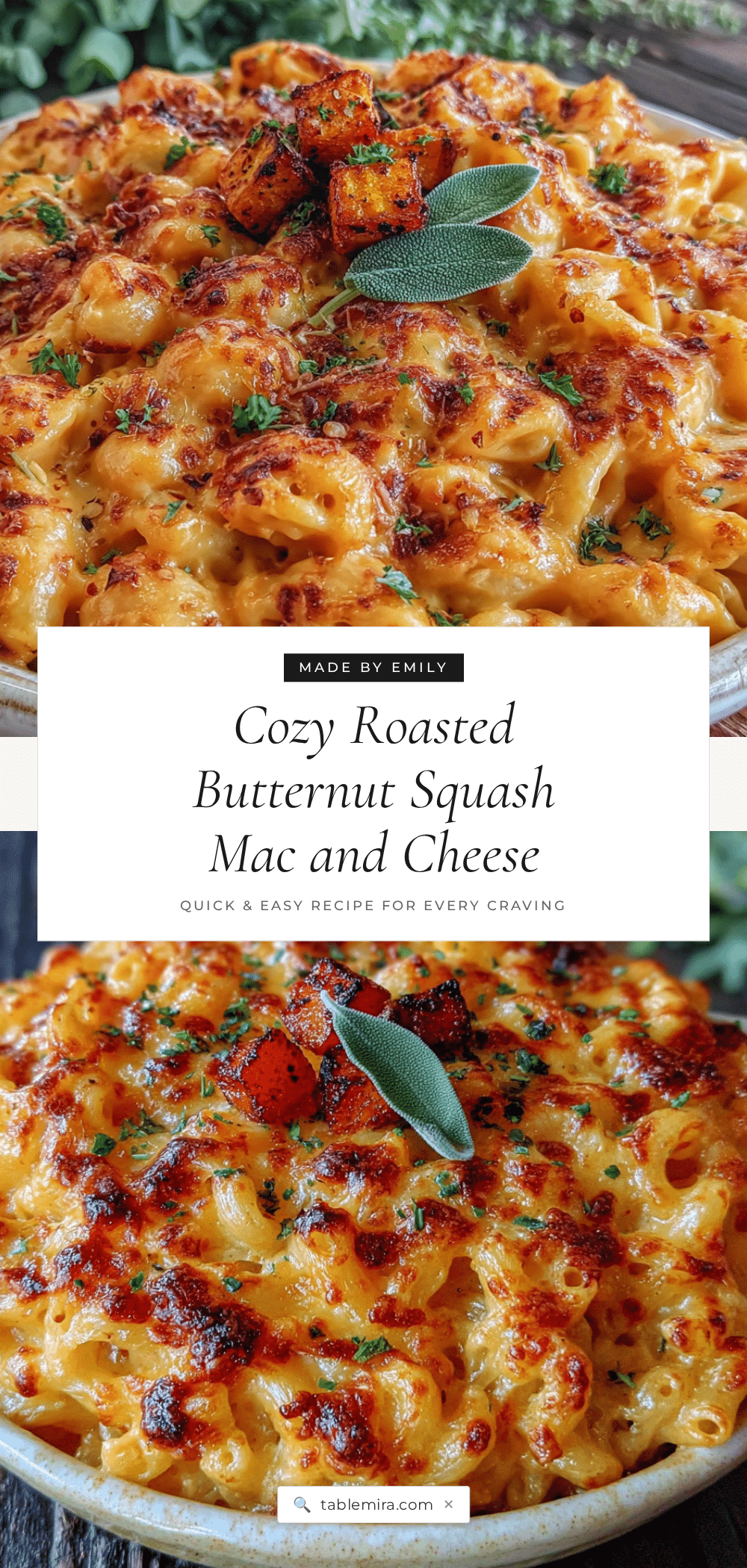
Easy Roasted Butternut Squash Mac and Cheese

This creamy, cozy mac and cheese gets a secret boost from roasted butternut squash, making it a crowd-pleasing comfort food that’s perfect for weeknights or potlucks.
- Prep Time: 15 minutes
- Cook Time: 30 minutes
- Total Time: 45 minutes
- Yield: 8 servings 1x
- Category: Main Course
- Cuisine: American
Ingredients
- 1 medium butternut squash (about 2–3 pounds), peeled, seeded, and cubed into 1-inch pieces
- 2 tablespoons olive oil
- 1/2 teaspoon salt
- 1/4 teaspoon black pepper
- 1/4 teaspoon garlic powder (optional)
- 1 pound (16 ounces) elbow macaroni (or any short pasta like cavatappi, shells, or rotini)
- 4 tablespoons (1/2 stick) unsalted butter
- 1/4 cup all-purpose flour
- 3 cups whole milk
- 1 cup heavy cream (optional)
- 2 cups shredded sharp cheddar cheese
- 1 cup shredded Gruyère or fontina cheese (optional)
- 1/2 cup grated Parmesan cheese
- 1 teaspoon Dijon mustard
- 1/2 teaspoon smoked paprika
- 1/4 teaspoon nutmeg
- Salt and pepper to taste
- 1/2 cup panko breadcrumbs (for topping, optional)
- 2 tablespoons unsalted butter, melted (for topping, optional)
- 1/4 cup grated Parmesan cheese (for topping, optional)
- 1 tablespoon fresh thyme or sage leaves (for topping, optional)
Instructions
- Preheat oven to 400°F (200°C). Line a rimmed baking sheet with parchment paper.
- Place cubed butternut squash on the prepared baking sheet. Drizzle with olive oil, sprinkle with salt, pepper, and garlic powder (if using). Toss to coat evenly and spread in a single layer.
- Roast for 25-30 minutes, flipping halfway, until tender and caramelized. Let cool slightly.
- Transfer roasted squash to a blender or food processor. Add about 1/4 cup water or milk and blend until completely smooth. Set aside.
- While squash roasts, bring a large pot of salted water to a boil. Cook pasta according to package directions until al dente. Drain (do not rinse) and set aside.
- In a medium saucepan, melt butter over medium heat. Whisk in flour and cook for 1 minute, whisking constantly, until golden and nutty.
- Slowly pour in milk and heavy cream (if using), whisking continuously. Cook for 3-5 minutes until thickened and coats the back of a spoon.
- Reduce heat to low. Whisk in Dijon mustard, smoked paprika, and nutmeg.
- Gradually add shredded cheddar, Gruyère (if using), and Parmesan cheese, a handful at a time, stirring until each addition is melted before adding the next.
- Stir in butternut squash puree until fully incorporated. Season with salt and pepper to taste.
- Preheat oven to 375°F (190°C). Grease a 9×13-inch baking dish.
- In a large bowl, combine cooked pasta and cheese sauce. Stir until coated. Pour into prepared baking dish and spread evenly.
- If making topping, combine panko breadcrumbs, melted butter, Parmesan cheese, and fresh herbs in a small bowl. Sprinkle over mac and cheese.
- Bake for 20-25 minutes until bubbly and topping is golden brown. For extra crispiness, broil for the last 2 minutes.
- Let rest for 5 minutes before serving.
Notes
Don’t skip roasting the squash—it adds depth of flavor. Grate your own cheese for a smooth sauce. For make-ahead, assemble without topping, refrigerate, then add topping and bake (add 10 minutes). Leftovers keep for up to 5 days in the fridge or freeze for up to 3 months.
Nutrition
- Serving Size: 1 serving (about 1/8
- Calories: 520
- Sugar: 8
- Sodium: 680
- Fat: 28
- Saturated Fat: 16
- Carbohydrates: 48
- Fiber: 4
- Protein: 20
Keywords: butternut squash mac and cheese, roasted squash mac and cheese, easy mac and cheese, comfort food, vegetarian mac and cheese, creamy mac and cheese