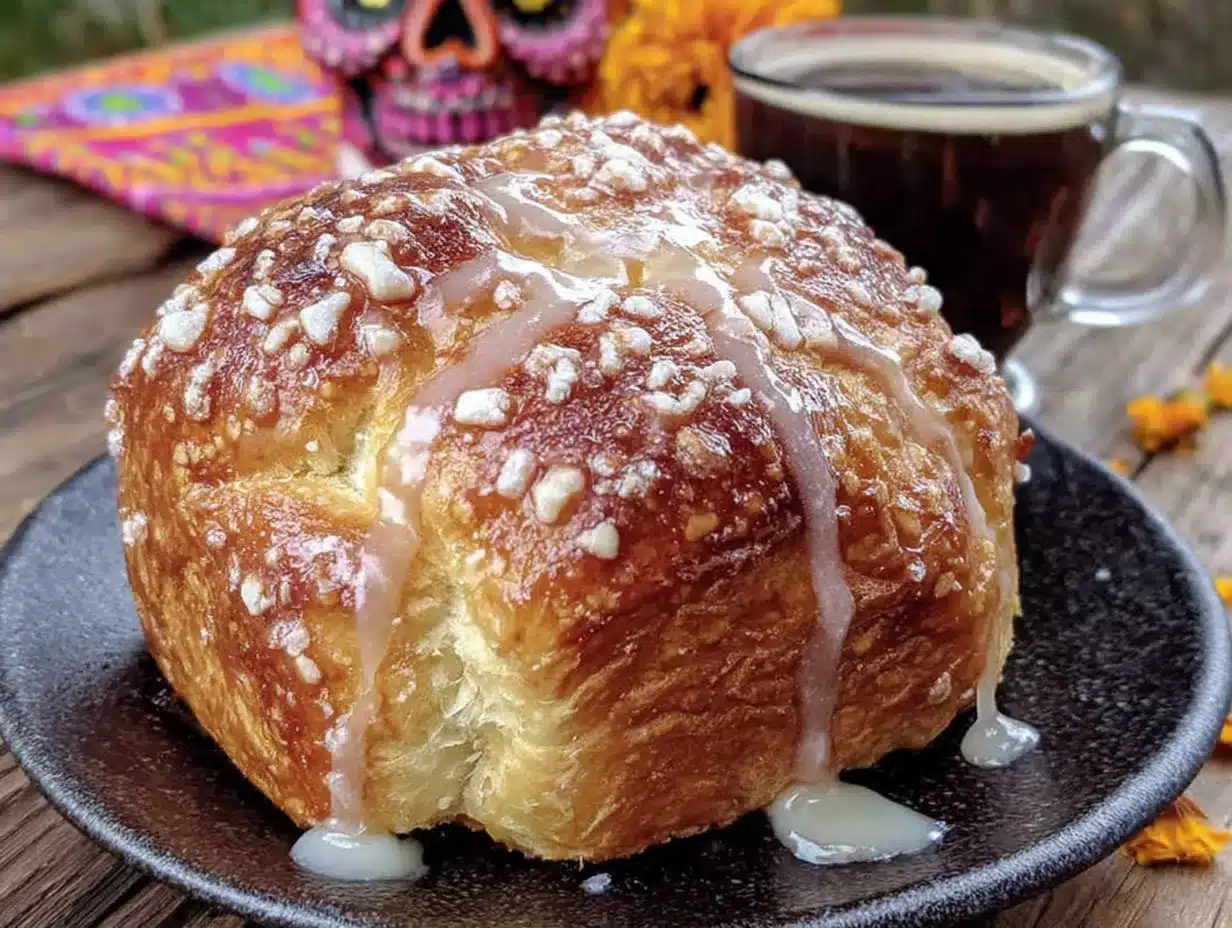
It was 11:47 PM on a drizzly Tuesday in late October, and I had a sudden, almost violent craving for something yeasty and soft and kissed with orange. I didn’t have the traditional dried flor de azahar (orange blossom water) that my abuela always used, but I had a dusty bottle of orange blossom honey from a farmer’s market trip six months ago and a half-bag of bread flour that was staring at me from the pantry. The idea arrived between one raindrop and the next: I would make Pan de Muerto, but not the fussy, all-day version. I would make the version that feels like a hug at 11 PM, when the world is quiet and the only person you have to impress is yourself.
Honestly, I was a little intimidated at first. Pan de Muerto is one of those breads that carries so much meaning—it’s baked for Día de Muertos, a celebration of life and memory, and the little bone-shaped decorations on top are supposed to represent the souls of the departed. That’s a lot of pressure for a Tuesday night baking project. But here’s the thing: I’ve learned over the years that the best recipes are the ones you make with your hands and your heart, not just with a strict list of rules. So I rolled up my sleeves, cranked up some old boleros on my phone, and just started mixing.
Maybe you’ve been there—staring at a recipe that feels too sacred to touch, too complicated for a weeknight, too “authentic” for your skill level. Let me tell you, this cozy Pan de Muerto with Orange Blossom Glaze is the antidote to that fear. It’s forgiving. It’s warm. It fills your kitchen with the kind of scent that makes neighbors text you at midnight asking what you’re baking. And that glaze? The orange blossom honey melts into the warm bread like a secret you’re finally ready to share. I keep making this version because it reminds me that tradition doesn’t have to be rigid—it can be flexible, personal, and made with whatever you have on hand at 11:47 PM on a rainy Tuesday.
Why You’ll Love This Recipe
I’ve tested this recipe six times over the past two months—once with all-purpose flour, once with a honey that was definitely too floral, and once where I forgot the yeast (don’t ask). What I landed on is a version that balances tradition with real-life practicality. This isn’t just another bread recipe; it’s the one that makes you feel like a pastry chef even when you’re wearing pajamas.
- Quick & Easy: From start to finish, this cozy Pan de Muerto comes together in about 2.5 hours—most of which is hands-off rising time. Perfect for a lazy weekend morning or a therapeutic evening bake.
- Simple Ingredients: No hunting down obscure Mexican grocery items. You need flour, yeast, butter, eggs, sugar, salt, and that one special ingredient—orange blossom honey or water. You probably have most of this already.
- Perfect for Día de Muertos & Cozy Nights: Whether you’re honoring loved ones or just craving something warm and sweet, this bread fits the moment. It’s equally at home on an ofrenda or on your coffee table with a cup of tea.
- Crowd-Pleaser: I brought a loaf to my neighbor Marta, and she called me at 7 AM the next day asking for the recipe. Kids love the sweet glaze, and adults appreciate the subtle floral notes.
- Unbelievably Delicious: The texture is soft and pillowy—think brioche’s slightly less fancy cousin—and the orange blossom glaze adds a fragrant sweetness that lingers. It’s comfort in bread form.
What makes this recipe different from all the others? It’s the glaze, honestly. Most Pan de Muerto recipes either skip the glaze entirely or use plain granulated sugar. My version uses orange blossom honey (or orange blossom water mixed with honey) brushed onto the warm bread, creating a sticky, fragrant crust that’s absolutely addictive. Plus, I’ve streamlined the shaping process so you don’t need to be a bread-baking pro to get those iconic bone shapes right.
This recipe isn’t just good—it’s the kind that makes you close your eyes after the first bite. It’s tradition made accessible, comfort food with a story, and the perfect way to bring a little warmth into your kitchen, no matter the season.
What Ingredients You Will Need
This cozy Pan de Muerto uses simple, wholesome ingredients to deliver that signature soft texture and floral aroma. Most of these are pantry staples, and the orange blossom element is the star that makes this bread unforgettable.
For the Dough
- All-purpose flour, 4 cups (500g) – Bread flour works too for a chewier texture, but AP flour gives that soft, tender crumb I love.
- Active dry yeast, 2 ¼ teaspoons (one packet) – I prefer Red Star or SAF instant yeast for consistent results. Make sure your yeast is fresh—check the expiration date!
- Warm milk, ¾ cup (180ml) – Whole milk adds richness, but 2% works fine. Heat to about 110°F—warm but not hot to the touch.
- Granulated sugar, ½ cup (100g) – This bread is lightly sweet, so don’t reduce it too much or the yeast won’t have enough to feed on.
- Unsalted butter, ½ cup (113g), softened – Salted butter works if you reduce the added salt slightly. I recommend Kerrygold for its creamy richness.
- Large eggs, 3, room temperature – Cold eggs can shock the dough. Leave them out for 30 minutes before starting.
- Orange zest, 2 tablespoons – From about 2 large oranges. This is where the fresh citrus flavor comes from.
- Salt, 1 teaspoon – Fine sea salt is best; it dissolves more evenly.
- Vanilla extract, 1 teaspoon – Pure vanilla, not imitation. It rounds out the floral notes beautifully.
For the Orange Blossom Glaze
- Orange blossom honey, ⅓ cup (115g) – This is the magic ingredient. You can find it at specialty grocery stores or online. If you can’t find it, use regular honey mixed with 1 tablespoon orange blossom water.
- Fresh orange juice, 2 tablespoons – From the same oranges you zested. Fresh makes a big difference here.
- Unsalted butter, 2 tablespoons (28g), melted – Adds richness and helps the glaze soak into the warm bread.
- Pinch of salt – Just a tiny pinch to balance the sweetness.
For Decoration (Optional but Traditional)
- Granulated sugar, ¼ cup (50g) – For sprinkling on top after glazing. It adds a lovely crunch.
- Orange zest strips – Thin strips of orange peel for garnish. Use a vegetable peeler for long, elegant curls.
Ingredient Tip: Orange blossom honey can be a bit pricey, but a little goes a long way. One jar will last you through many batches of this bread, and you can use it in tea or drizzled over yogurt too. If you’re dairy-free, swap the butter for a good vegan butter like Miyoko’s—I’ve tested it, and it works perfectly.
Equipment Needed
You don’t need a professional bakery setup for this cozy Pan de Muerto. Here’s what I use and what you can substitute if needed.
- Stand mixer with dough hook – This is my preferred method because kneading for 10 minutes by hand can be tiring. A KitchenAid or similar works great. If you don’t have one, a large mixing bowl and a sturdy wooden spoon will do—just expect a longer knead time.
- Large mixing bowl – For rising the dough. Glass or ceramic works best because they retain warmth better than metal.
- Baking sheet – A standard half-sheet pan (18×13 inches) is perfect. Line it with parchment paper for easy cleanup.
- Pastry brush – For applying the glaze. A silicone brush is easier to clean, but a natural bristle brush works too.
- Plastic wrap or a clean kitchen towel – To cover the dough while it rises. A damp towel can help keep the dough from drying out.
- Cooling rack – Essential for letting the bread cool evenly after baking. If you don’t have one, just let it cool on the baking sheet for 10 minutes, then transfer to a plate.
- Microplane or fine grater – For zesting the oranges. A box grater works in a pinch, but a microplane gives you finer zest that incorporates better into the dough.
Budget-Friendly Tip: You can absolutely knead this dough by hand. It takes about 12-15 minutes of steady work, but there’s something meditative about it. I actually prefer hand-kneading when I’m feeling stressed—it’s like therapy with a floury side effect.
Preparation Method
Let’s make some cozy Pan de Muerto. I’ll walk you through every step, including the little things I’ve learned from my six test batches.
Step 1: Activate the Yeast (5 minutes)
In a small bowl, combine the warm milk (110°F) with 1 tablespoon of the sugar and the active dry yeast. Stir gently and let it sit for 5-10 minutes until it becomes foamy and smells pleasantly yeasty. If it doesn’t foam, your yeast might be dead—start over with fresh yeast. I learned this the hard way after one batch turned into a dense brick.
Step 2: Make the Dough (10-15 minutes)
In the bowl of your stand mixer (or a large mixing bowl), whisk together the flour, remaining sugar, orange zest, and salt. Add the softened butter, eggs, vanilla extract, and the foamy yeast mixture. Mix on low speed with the dough hook until a shaggy dough forms, about 2 minutes. Increase to medium speed and knead for 8-10 minutes (or 12-15 minutes by hand) until the dough is smooth, elastic, and pulls away from the sides of the bowl. It should be slightly tacky but not sticky—if it’s too wet, add a tablespoon of flour at a time.
Sensory Cue: The dough should feel like a baby’s cheek—soft, smooth, and slightly springy when you poke it. If it tears easily, keep kneading.
Step 3: First Rise (1-1.5 hours)
Shape the dough into a smooth ball and place it in a lightly greased large bowl. Cover with plastic wrap or a damp kitchen towel and let it rise in a warm, draft-free spot until doubled in size. This usually takes about 60-90 minutes. I like to put it in my oven with the light on—it’s the perfect warm environment. Don’t rush this step; the flavor develops during the rise.
Step 4: Shape the Bread (15 minutes)
Gently punch down the dough to release the air. Turn it out onto a lightly floured surface. Divide the dough into two pieces: one larger piece (about two-thirds of the dough) for the base, and one smaller piece (one-third) for the decorations.
Shape the large piece into a round loaf and place it on your parchment-lined baking sheet. Now for the fun part—the bones. Divide the smaller piece into 4 equal portions. Roll each portion into a long rope, about 6-8 inches long. Cut each rope into thirds. Take two of the small pieces and roll them into balls (these will be the “knuckles” on the bones). Place one ball at each end of a rope, pressing gently to attach. Repeat with the remaining ropes and balls. You should have 4 bone-shaped pieces.
Arrange the bones on top of the round loaf in a cross pattern—two bones crossing in the center, with the remaining two bones forming an X around them. Gently press them into the dough so they stick during baking. Finally, roll a small piece of remaining dough into a ball and place it in the very center, where the bones meet. This represents the skull.
Personal Tip: Don’t stress about making the bones perfect. My first attempt looked like lumpy worms, and it still tasted amazing. The bread remembers the intention, not the perfection.
Step 5: Second Rise (45-60 minutes)
Cover the shaped loaf loosely with plastic wrap and let it rise again until puffy and nearly doubled, about 45-60 minutes. It should feel light and airy when gently poked.
Step 6: Bake the Bread (25-30 minutes)
Preheat your oven to 350°F (175°C). Bake the bread for 25-30 minutes, until the top is golden brown and the loaf sounds hollow when tapped on the bottom. If the top is browning too quickly (after about 15 minutes), tent it loosely with foil. Let the bread cool on the baking sheet for 10 minutes, then transfer to a cooling rack.
Step 7: Make the Glaze (5 minutes)
While the bread is still warm (but not hot), make the glaze. In a small saucepan over low heat, combine the orange blossom honey, fresh orange juice, melted butter, and a pinch of salt. Stir until smooth and warmed through, about 2-3 minutes. Do not boil—you just want it warm and liquid.
Step 8: Glaze and Serve (5 minutes)
Using a pastry brush, generously brush the warm glaze all over the warm bread. The bread will absorb it like a sponge, creating that signature sticky-sweet crust. Sprinkle with granulated sugar and orange zest strips if desired. Let the glaze set for 10 minutes before slicing. Serve warm or at room temperature.
Cooking Tips & Techniques
I’ve made every mistake in the book with this cozy Pan de Muerto, so let me save you some trouble.
Don’t over-knead. I know, I know, you want a soft bread, but over-kneading develops too much gluten and makes the bread tough. Stop when the dough is smooth and passes the windowpane test—stretch a small piece of dough between your fingers; if it forms a thin, translucent membrane without tearing, you’re done.
Temperature matters. If your kitchen is cold (below 70°F), your dough will take forever to rise. I’ve been there—staring at a sad, unrisen blob at midnight. Solution: turn your oven to the lowest setting for 2 minutes, then turn it off and place the dough inside with the door slightly ajar. The residual warmth works wonders.
Glaze while warm. This is non-negotiable. If you wait until the bread is completely cool, the glaze will just sit on top instead of soaking in. You want that warm bread to drink up all that orange blossom goodness. Trust me on this—I glazed a cold loaf once, and it was a sad, sticky mess.
Multitasking tip: While the dough is doing its first rise, zest and juice your oranges, measure out your glaze ingredients, and clean up your workspace. Future you will be grateful.
Consistency is key: If your dough feels too dry during kneading, add warm milk one tablespoon at a time. If it’s too sticky, add flour one tablespoon at a time. The humidity in your kitchen affects the dough more than you’d think.
Variations & Adaptations
This cozy Pan de Muerto is wonderfully adaptable. Here are some variations I’ve tried and loved.
Vegan Version
Swap the butter for vegan butter (I like Miyoko’s), use flax eggs (1 tablespoon ground flaxseed + 3 tablespoons water per egg), and use plant-based milk. The texture will be slightly denser but still delicious. For the glaze, use maple syrup instead of honey.
Gluten-Free Version
Use a 1:1 gluten-free flour blend that contains xanthan gum, like Bob’s Red Mill. The dough will be stickier and harder to shape, so wet your hands with water when handling it. Bake for an extra 5-7 minutes. The bones might not hold their shape as well, but the flavor is still lovely.
Chocolate Orange Twist
Add ¼ cup cocoa powder to the dry ingredients and increase the sugar by 2 tablespoons. The chocolate-orange combination is absolutely divine—like a fancy Italian pastry but homemade. I made this version for a friend’s birthday, and she said it was the best bread she’d ever eaten.
Spiced Version
Add 1 teaspoon ground cinnamon, ½ teaspoon ground nutmeg, and ¼ teaspoon ground cloves to the dry ingredients. This gives the bread a warm, autumnal flavor that’s perfect for fall baking. I love this version with a cup of spiced chai.
Savory-Sweet Version
Reduce the sugar to ¼ cup and add 1 teaspoon dried rosemary or thyme to the dough. Skip the sweet glaze and brush the baked bread with melted butter and a sprinkle of flaky sea salt instead. This is surprisingly good with a cheese board.
Serving & Storage Suggestions
This cozy Pan de Muerto is best served warm, when the glaze is still slightly sticky and the bread is pillowy soft. I love it with a cup of Mexican hot chocolate or a simple café de olla. For a breakfast treat, slice it and toast it lightly, then spread with a little butter—the orange blossom flavor intensifies with heat.
Storage: Store the bread in an airtight container at room temperature for up to 3 days. Do not refrigerate—it will dry out the bread. If you live in a humid climate, keep it in a paper bag instead of plastic to prevent the glaze from getting too sticky.
Freezing: This bread freezes beautifully. Wrap the cooled, unglazed loaf tightly in plastic wrap, then in foil, and freeze for up to 3 months. When ready to serve, thaw overnight in the refrigerator, then warm in a 300°F oven for 10 minutes before glazing. I’ve done this multiple times, and it tastes just as fresh.
Reheating: The best way to reheat slices is in a toaster oven or under the broiler for 1-2 minutes. For a whole loaf, wrap it in foil and warm in a 300°F oven for 10-15 minutes. The glaze will get sticky again, which is exactly what you want.
Flavor Development: Honestly, this bread tastes even better on day two. The orange blossom flavor mellows and melds with the bread, creating a more complex, subtle taste. If you can resist eating it all on day one, you’re in for a treat.
Nutritional Information & Benefits
Per serving (1 slice, assuming 12 slices per loaf):
- Calories: 285
- Fat: 10g
- Carbohydrates: 44g
- Protein: 6g
- Fiber: 1g
- Sugar: 18g
While this is definitely a treat, it does offer some nutritional perks. Oranges are packed with vitamin C and antioxidants, and the orange blossom honey provides trace amounts of beneficial compounds. The eggs and butter add protein and healthy fats, which help keep you full and satisfied. Plus, there’s something to be said for the mental health benefits of baking—the process itself is meditative and grounding.
Dietary Considerations: This recipe contains gluten, dairy, and eggs. For allergen-friendly versions, see the variations section above. It’s not low-carb or keto-friendly, but it’s perfect for a balanced diet when enjoyed in moderation.
I personally believe that food like this—made with intention, shared with loved ones, and infused with tradition—nourishes more than just the body. It feeds the soul. And that’s worth every single calorie.
Conclusion
This cozy Pan de Muerto with Orange Blossom Glaze is more than just a recipe—it’s an invitation. An invitation to slow down, to honor traditions old and new, and to fill your kitchen with the kind of warmth that makes a house feel like a home. Whether you’re baking it for Día de Muertos, a cozy Sunday afternoon, or just because you need a little sweetness in your life, this bread delivers.
I love this recipe because it’s forgiving. It doesn’t demand perfection—it just asks for your time and attention. And in return, it gives you something that smells like love and tastes like memory. That’s pretty special, if you ask me.
Now I want to hear from you! Have you ever made Pan de Muerto before? What’s your favorite way to customize it? Drop a comment below and share your baking adventures. And if you try this recipe, tag me in your photos—I’d love to see your beautiful loaves. Happy baking, friends!
Frequently Asked Questions
Can I use orange blossom water instead of orange blossom honey?
Absolutely! If you have orange blossom water, use 2 tablespoons mixed with ¼ cup regular honey for the glaze. For the dough, you can add 1 teaspoon of orange blossom water along with the vanilla extract for extra floral flavor.
My dough isn’t rising. What went wrong?
This usually happens for one of three reasons: your yeast was expired or killed by hot liquid (milk should be 110°F, not hotter), your kitchen is too cold, or your salt came into direct contact with the yeast. Check your yeast’s expiration date, use a thermometer for the milk, and make sure to mix the salt into the flour before adding the yeast mixture.
Can I make this bread ahead of time?
Yes! You can prepare the dough through the first rise, then punch it down, wrap it tightly, and refrigerate overnight. The next day, let it come to room temperature for about an hour before shaping and proceeding with the second rise. The cold fermentation actually develops more flavor.
How do I know when the bread is fully baked?
Tap the bottom of the loaf—it should sound hollow. You can also use an instant-read thermometer; the internal temperature should be 190-200°F. If the top is browning too quickly but the bread isn’t done, tent it loosely with foil for the last 10 minutes of baking.
Can I skip the glaze?
You can, but I wouldn’t recommend it. The glaze is what makes this Pan de Muerto special—it adds moisture, sweetness, and that signature orange blossom aroma. If you want a less sweet version, just brush the warm bread with melted butter and sprinkle with a little cinnamon sugar instead.
Pin This Recipe!
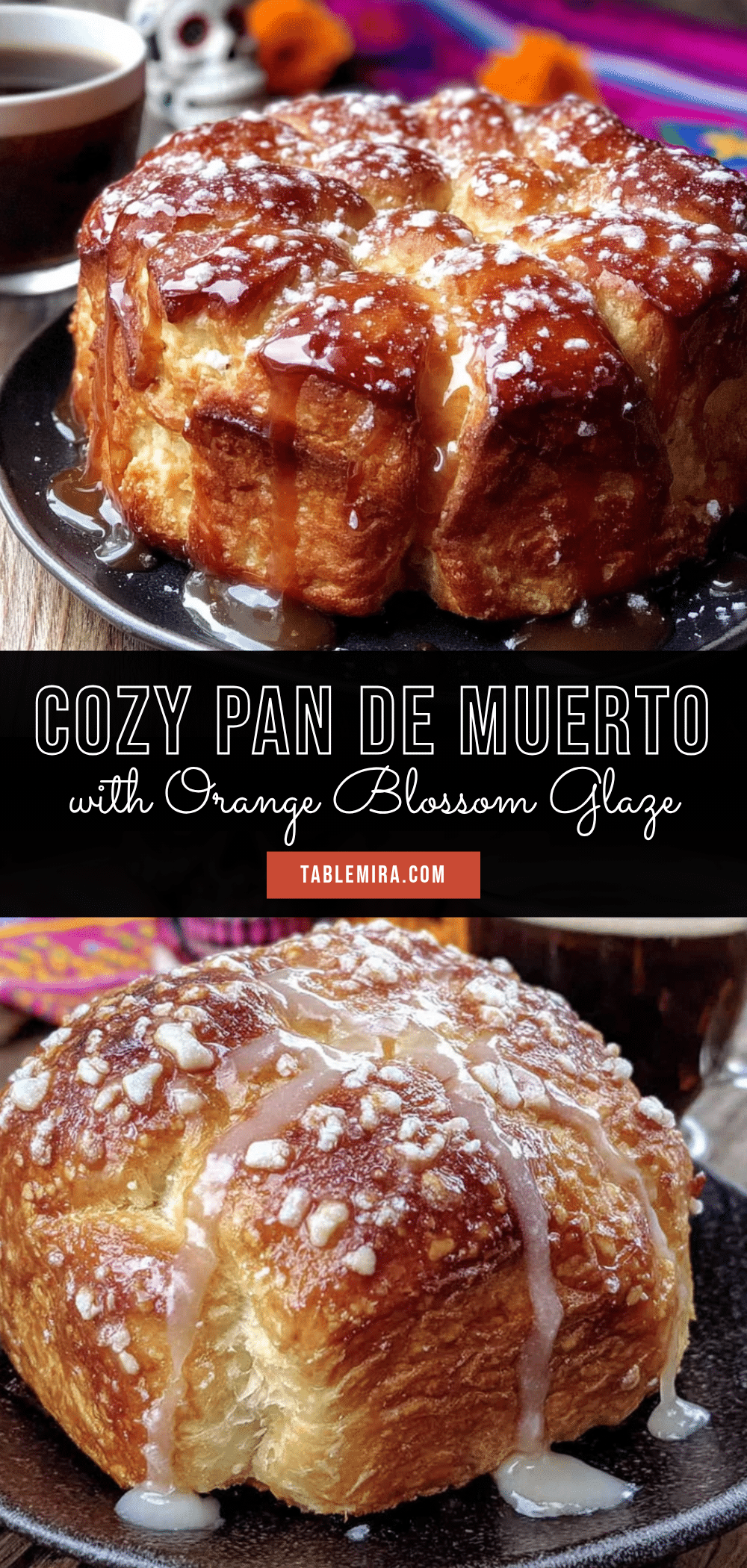
Cozy Pan de Muerto with Orange Blossom Glaze (Easy Recipe)

A forgiving, warm, and aromatic Pan de Muerto bread made with orange blossom honey glaze. Perfect for Día de Muertos or a cozy night in, this simplified version balances tradition with real-life practicality.
- Prep Time: 20 minutes
- Cook Time: 30 minutes
- Total Time: 2 hours 30 minutes
- Yield: 12 servings 1x
- Category: Bread
- Cuisine: Mexican
Ingredients
- 4 cups (500g) all-purpose flour
- 2 ¼ teaspoons active dry yeast (one packet)
- ¾ cup (180ml) warm milk (110°F)
- ½ cup (100g) granulated sugar
- ½ cup (113g) unsalted butter, softened
- 3 large eggs, room temperature
- 2 tablespoons orange zest
- 1 teaspoon salt
- 1 teaspoon vanilla extract
- ⅓ cup (115g) orange blossom honey
- 2 tablespoons fresh orange juice
- 2 tablespoons (28g) unsalted butter, melted
- Pinch of salt
- ¼ cup (50g) granulated sugar (for decoration)
- Orange zest strips (for garnish)
Instructions
- Activate the yeast: In a small bowl, combine warm milk (110°F) with 1 tablespoon of sugar and active dry yeast. Stir gently and let sit for 5-10 minutes until foamy.
- Make the dough: In a stand mixer bowl, whisk together flour, remaining sugar, orange zest, and salt. Add softened butter, eggs, vanilla extract, and foamy yeast mixture. Mix on low speed with dough hook until shaggy, about 2 minutes. Increase to medium speed and knead for 8-10 minutes (12-15 minutes by hand) until smooth, elastic, and slightly tacky.
- First rise: Shape dough into a smooth ball and place in a lightly greased bowl. Cover with plastic wrap or a damp towel and let rise in a warm spot until doubled, about 60-90 minutes.
- Shape the bread: Punch down dough and divide into two pieces (two-thirds for base, one-third for decorations). Shape large piece into a round loaf on a parchment-lined baking sheet. Divide small piece into 4 portions, roll each into a 6-8 inch rope, cut each into thirds. Roll two small pieces into balls for ‘knuckles’ and attach to ends of each rope. Arrange 4 bone-shaped pieces on top of loaf in a cross pattern, with a small ball in the center.
- Second rise: Cover shaped loaf loosely and let rise until puffy and nearly doubled, about 45-60 minutes.
- Bake: Preheat oven to 350°F (175°C). Bake for 25-30 minutes until golden brown and hollow-sounding when tapped. Tent with foil if browning too quickly. Cool on baking sheet for 10 minutes, then transfer to a cooling rack.
- Make the glaze: While bread is warm, combine orange blossom honey, fresh orange juice, melted butter, and a pinch of salt in a small saucepan over low heat. Stir until smooth and warmed through, about 2-3 minutes. Do not boil.
- Glaze and serve: Brush warm glaze generously over warm bread. Sprinkle with granulated sugar and orange zest strips. Let set for 10 minutes before slicing. Serve warm or at room temperature.
Notes
Don’t over-knead; stop when dough passes windowpane test. Glaze while bread is warm for best absorption. For cold kitchens, let dough rise in oven with light on. Bread tastes even better on day two. Freezes well unglazed for up to 3 months.
Nutrition
- Serving Size: 1 slice
- Calories: 285
- Sugar: 18
- Sodium: 200
- Fat: 10
- Saturated Fat: 6
- Carbohydrates: 44
- Fiber: 1
- Protein: 6
Keywords: Pan de Muerto, Día de Muertos, orange blossom, bread, Mexican bread, holiday bread, sweet bread, orange blossom honey