I was standing in the frozen foods aisle last November—a Tuesday, I think—when the smell of orange and something warm and floral hit me out of nowhere. A woman walked past holding one of those plug-in air fresheners, and just like that, I was seven years old in Mrs. Valenzuela’s kitchen, watching her roll little dough skulls between her palms. She lived three houses down from my abuela, and every October her whole house smelled like that—orange zest, anise, and butter melting into flour. I never learned her recipe. She moved away when I was nine, and I never saw her again. But that smell? It never left me.
I’ve spent years trying to recreate it. The first few attempts were, honestly, a disaster. Too dry. Too dense. One batch came out looking like sad bread hockey pucks. My husband tried to be nice about it—”It’s the thought that counts, babe”—but we both knew. I mean, Pan de Muerto isn’t just bread. It’s a bridge. You know that feeling when you’re trying to hold onto something that’s already slipping away? That’s what this bread is for. It’s for remembering. For setting a place at the table for someone who can’t be there.
This version—with the orange blossom glaze—is the one that finally felt right. It’s soft, almost pillowy, with just enough sweetness to feel special without being cloying. The glaze adds this fragrant floral note that makes the whole kitchen smell like a garden in bloom. Maybe you’ve been there, chasing a taste from your past that you can’t quite name. This is that bread. And I’m so glad I kept trying.
Why You’ll Love This Recipe
Let me tell you why this particular Pan de Muerto recipe is the one you’ll come back to year after year. I tested it six times before I got the texture exactly right—not too cakey, not too bread-like, but that perfect in-between that makes you close your eyes after the first bite. It’s comfort food reimagined for the home baker who wants something beautiful without spending all day in the kitchen.
- Quick & Easy: Comes together in about 3 hours total, with most of that being rise time. Active work? Maybe 30 minutes. Perfect for a weekend afternoon.
- Simple Ingredients: No weird specialty items. Flour, yeast, butter, eggs, orange zest, and a little anise seed. You probably have most of it already.
- Perfect for Día de Muertos: Whether you’re setting up an ofrenda or just want to honor loved ones in your own way, this bread belongs on the table.
- Crowd-Pleaser: My picky nephew who “doesn’t like bread” ate three pieces. I’m not kidding.
- Unbelievably Delicious: The orange blossom glaze takes it from “good homemade bread” to “what bakery did you get this from?” territory.
What makes this different from other recipes? Two things. First, I use a tangzhong method—basically a cooked flour paste—that keeps the bread incredibly soft for days. Second, the orange blossom glaze isn’t just a drizzle; it’s brushed on while the bread is still warm so it soaks in and perfumes every bite. This isn’t just another version of Pan de Muerto. It’s the one that actually works for home bakers.
What Ingredients You Will Need
This recipe uses simple, wholesome ingredients to deliver that signature soft texture and fragrant flavor. Most of these are pantry staples, which makes this surprisingly easy to pull together on a whim.
For the Tangzhong (Flour Paste)
- 3 tablespoons bread flour
- 1/2 cup water
For the Dough
- 3 1/2 cups bread flour (plus more for dusting)
- 1/4 cup granulated sugar
- 2 1/4 teaspoons active dry yeast (one packet)
- 1 teaspoon salt
- 1 teaspoon anise seed (lightly crushed—this is the secret to that authentic flavor)
- Zest of 2 oranges
- 1/2 cup whole milk, warm (about 110°F)
- 2 large eggs, room temperature
- 1/4 cup unsalted butter, softened (I use Kerrygold for the richer flavor)
- 1 teaspoon vanilla extract
For the Orange Blossom Glaze
- 1 cup powdered sugar, sifted
- 2 tablespoons orange blossom water
- 1 tablespoon fresh orange juice
- Zest of 1 orange
For the Topping
- 1 large egg, beaten with 1 tablespoon water (egg wash)
- 2 tablespoons granulated sugar (for sprinkling)
- Optional: a few drops of orange food coloring for a traditional touch
A few notes on ingredients. The anise seed is non-negotiable in my book—it gives that subtle licorice note that makes Pan de Muerto taste like Pan de Muerto. If you can’t find orange blossom water (check the international aisle or a Middle Eastern market), you can substitute with 2 tablespoons of fresh orange juice plus 1/2 teaspoon orange extract. But honestly, the real stuff is worth tracking down. I use Cortas brand—it’s affordable and widely available online.
For the bread flour, King Arthur is my go-to. It has a higher protein content which gives the bread better structure and that soft, chewy crumb. If you only have all-purpose flour, it will still work, but the texture won’t be quite as tender.
Equipment Needed
You don’t need much fancy equipment for this recipe, which is part of its charm. Here’s what you’ll need:
- Stand mixer with dough hook (you can knead by hand, but it’ll take about 15 minutes and your arms will feel it)
- Large mixing bowl (glass or ceramic works best)
- Baking sheet, lined with parchment paper
- Small saucepan for the tangzhong
- Whisk
- Pastry brush (a silicone one is great for the glaze)
- Bench scraper or sharp knife for shaping the dough
- Plastic wrap or a clean kitchen towel for covering the dough
- Cooling rack
If you don’t have a stand mixer, don’t sweat it. I actually made my first successful batch by hand because my mixer was on the fritz. It’s a good arm workout, and there’s something meditative about kneading dough. Just make sure you flour your surface well and use a rhythmic push-fold-turn motion. Your dough is ready when it’s smooth and springs back when you poke it.
Preparation Method
Step 1: Make the Tangzhong
In a small saucepan, whisk together the 3 tablespoons of bread flour and 1/2 cup water until smooth. Cook over medium heat, stirring constantly, until the mixture thickens into a paste—about 2-3 minutes. It should look like thick pudding. Remove from heat and let it cool to room temperature. This step is magic; it gelatinizes the starch so the bread stays soft for days.
Step 2: Bloom the Yeast
In the bowl of your stand mixer, combine the warm milk (about 110°F—warm but not hot, like bathwater), 1 tablespoon of the sugar, and the yeast. Give it a stir and let it sit for 5-10 minutes until it’s foamy. If it doesn’t foam, your yeast might be dead. Start over with fresh yeast—trust me, I’ve learned this the hard way.
Step 3: Mix the Dough
Add the remaining sugar, salt, crushed anise seed, orange zest, eggs, vanilla, the cooled tangzhong, and 2 cups of the bread flour to the yeast mixture. Mix on low speed with the dough hook until combined. Add the softened butter, then gradually add the remaining 1 1/2 cups of flour, 1/2 cup at a time. Mix on medium-low for 8-10 minutes. The dough should be soft, smooth, and slightly tacky but not sticky. If it’s sticking to the bowl, add a tablespoon more flour at a time.
Step 4: First Rise
Transfer the dough to a lightly oiled bowl, turning once to coat. Cover with plastic wrap or a damp kitchen towel and let it rise in a warm spot for 1 1/2 to 2 hours, until doubled in size. I like to put mine in the oven with the light on—it stays perfectly warm in there. The dough should feel puffy and airy when you poke it.
Step 5: Shape the Bread
Punch the dough down gently and turn it onto a lightly floured surface. Divide it into two pieces—one larger piece (about 2/3 of the dough) for the base, and one smaller piece (1/3) for the decorations. Shape the large piece into a round ball and place it on your parchment-lined baking sheet.
For the decorations, divide the small piece into four equal parts. Roll three into long ropes about 6 inches long—these will be the “bones” on top. Shape them to look like bones by pinching the ends slightly. Place them across the top of the round loaf, spacing them evenly. Roll the fourth piece into a small ball for the top center “skull.” Press it gently into the center where the bones meet.
Step 6: Second Rise
Cover the shaped loaf loosely with plastic wrap and let it rise for another 45 minutes to 1 hour, until it’s puffy and almost doubled. It should feel light when you gently touch it.
Step 7: Bake
Preheat your oven to 350°F (175°C). Brush the risen loaf with the egg wash, being careful not to deflate it. Sprinkle generously with the 2 tablespoons of granulated sugar. Bake for 25-30 minutes, until the top is deep golden brown and the loaf sounds hollow when tapped on the bottom. If the top is browning too fast, tent it with foil halfway through.
Step 8: Glaze
While the bread bakes, make the glaze. Whisk together the powdered sugar, orange blossom water, orange juice, and orange zest until smooth. The glaze should be thick but pourable. As soon as the bread comes out of the oven, brush it generously with the glaze while it’s still warm. The glaze will soak in and create that beautiful floral finish. Let it cool on the baking sheet for 10 minutes, then transfer to a cooling rack.
Cooking Tips & Techniques
Let me save you from the mistakes I made. First, temperature matters more than you think. If your milk is too hot (above 115°F), it’ll kill the yeast. Too cold, and the yeast won’t activate. Use a thermometer if you have one—I didn’t for years and wondered why my bread was hit or miss. Now I never skip this step.
Second, don’t over-flour your surface when shaping. A lightly oiled surface actually works better for this dough. If it’s sticking, use a bench scraper to lift it rather than dumping more flour on top. Too much flour makes the bread dense and heavy.
Here’s something I learned the hard way: anise seed needs to be crushed lightly to release its flavor. I used whole seeds in my first batch and wondered why the bread barely tasted like anything. Give them a quick crush with a mortar and pestle or the bottom of a heavy pan. Just don’t pulverize them—you want little flecks throughout the dough.
For the glaze, timing is everything. Brush it on while the bread is still warm from the oven—within the first 5 minutes. If you wait until it’s cool, the glaze just sits on top instead of soaking in. The warm bread absorbs the orange blossom water and creates that fragrant, almost ethereal flavor that makes this bread so special.
Variations & Adaptations
One of my favorite things about this recipe is how adaptable it is. Here are some ways to make it your own:
Dairy-Free Version
Swap the whole milk for oat milk or almond milk, and use vegan butter. I’ve tested this with Miyoko’s European Style Cultured Butter and it works beautifully. The texture is slightly less tender, but the flavor is still fantastic.
Chocolate Twist
Add 1/4 cup of cocoa powder to the flour mixture and reduce the flour by 2 tablespoons. The chocolate pairs surprisingly well with the orange blossom glaze—think chocolate orange, but in bread form. My sister-in-law requests this version every year.
Spiced Variation
Add 1 teaspoon of cinnamon and 1/2 teaspoon of nutmeg to the dough along with the anise seed. This gives the bread a warmer, more festive flavor that’s perfect for fall. I made this version last November and it disappeared in one evening.
Gluten-Free Option
Use a 1:1 gluten-free flour blend that contains xanthan gum. Cup4Cup works best in my testing. The texture will be more cake-like than bread-like, but it’s still delicious. Note that you may need to add an extra tablespoon of milk to compensate for the drier gluten-free flour.
Serving & Storage Suggestions
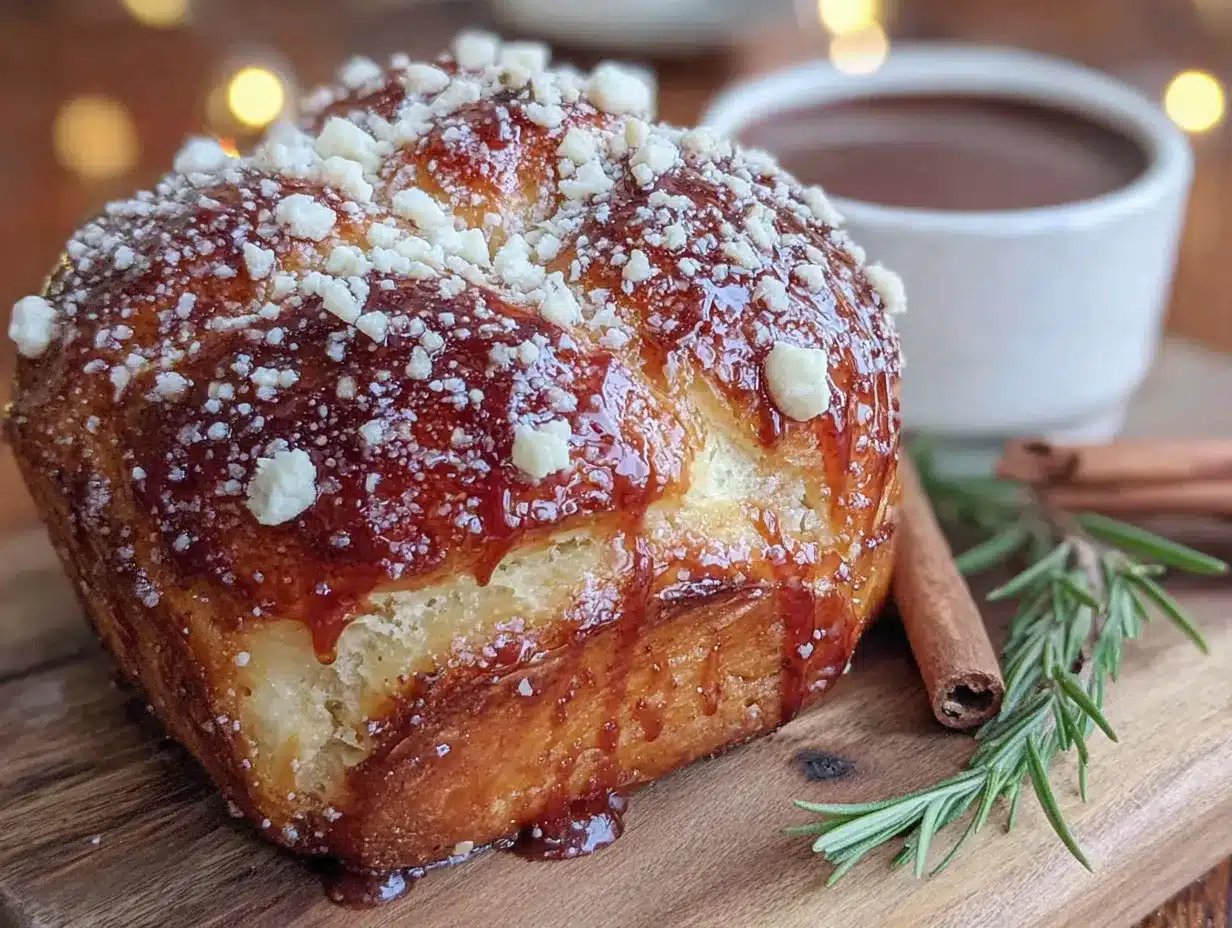
Pan de Muerto is best served warm, ideally within a few hours of baking. The glaze is still slightly soft and the bread is pillowy and fragrant. Serve it with a cup of Mexican hot chocolate or café de olla—the cinnamon and piloncillo notes in both drinks complement the orange blossom beautifully.
For a traditional presentation, arrange the bread on a plate with marigold petals (the real flower, not the French marigold) around it. It’s a stunning visual that honors the Día de Muertos tradition. If you’re setting up an ofrenda, place the bread alongside photos of your loved ones, candles, and sugar skulls.
To store, wrap the bread tightly in plastic wrap once it’s completely cool. It will stay soft for 3-4 days at room temperature. Do not refrigerate—it will dry out the bread. If you need to keep it longer, freeze it (wrapped in plastic, then foil) for up to 2 months. To reheat, unwrap and warm in a 300°F oven for 10 minutes. The glaze will soften and the bread will taste almost fresh-baked.
Honestly, the flavors get better on day two. The orange blossom glaze continues to perfume the bread, and the crumb becomes even more tender. If you can resist eating it all in one sitting, you’re stronger than me.
Nutritional Information & Benefits
Per serving (1/8 of the loaf): approximately 320 calories, 8g fat, 54g carbohydrates, 8g protein, 2g fiber, 18g sugar. This is a treat, not an everyday bread, and that’s okay. It’s meant to be shared and savored.
That said, there are some bright spots. The orange zest provides a good dose of vitamin C and antioxidants. The anise seed has been used traditionally to aid digestion—which is handy after a rich meal. And the eggs add high-quality protein. Is it health food? No. But it’s food made with intention and love, and that counts for something.
For those watching their sugar, you can reduce the glaze sugar by half and it will still be lovely—just thinner and less sweet. The bread itself is not overly sweet, so the glaze is where most of the sugar lives.
Conclusion
This Pan de Muerto recipe is more than just bread. It’s a way to slow down, to remember, to connect with something bigger than ourselves. The orange blossom glaze makes it feel special, but the real magic is in the process—the kneading, the shaping, the waiting. It’s a meditation on patience and memory.
I hope you make this for your loved ones, whether they’re at your table or in your heart. Customize it, make it your own, and don’t stress about perfection. The first time I made this, my “bones” looked more like sad worms, and it still tasted incredible. That’s the thing about homemade bread—it always carries the warmth of whoever made it.
I’d love to hear how yours turns out. Drop a comment below with your variations or questions. And if you make this for your ofrenda, tell me who you’re remembering. I’ll be thinking of Mrs. Valenzuela when I take my first bite.
Frequently Asked Questions
Can I make Pan de Muerto without a stand mixer?
Absolutely. Knead by hand for 12-15 minutes until the dough is smooth and elastic. It’s a great arm workout, and there’s something satisfying about feeling the dough come together under your hands.
Can I substitute the anise seed with something else?
You can use fennel seed or even a teaspoon of anise extract, but the flavor will be different. Anise seed is traditional and gives that distinctive licorice note. If you really don’t like licorice, you can leave it out entirely—the bread will still be delicious, just more neutral.
How do I know when the bread is fully baked?
The top should be deep golden brown, and the loaf should sound hollow when you tap the bottom. If you have an instant-read thermometer, the internal temperature should be 190°F (88°C).
Can I freeze the unbaked dough?
Yes! After shaping, place the loaf on a baking sheet and freeze until solid. Then wrap tightly in plastic wrap and foil. When ready to bake, thaw in the refrigerator overnight, let it come to room temperature for 30 minutes, then proceed with the egg wash and baking.
What if I can’t find orange blossom water?
You can substitute with 2 tablespoons of fresh orange juice plus 1/2 teaspoon orange extract. The flavor won’t be quite as floral, but it will still be delicious. Alternatively, you can use rose water for a different but equally lovely flavor profile.
Pin This Recipe!
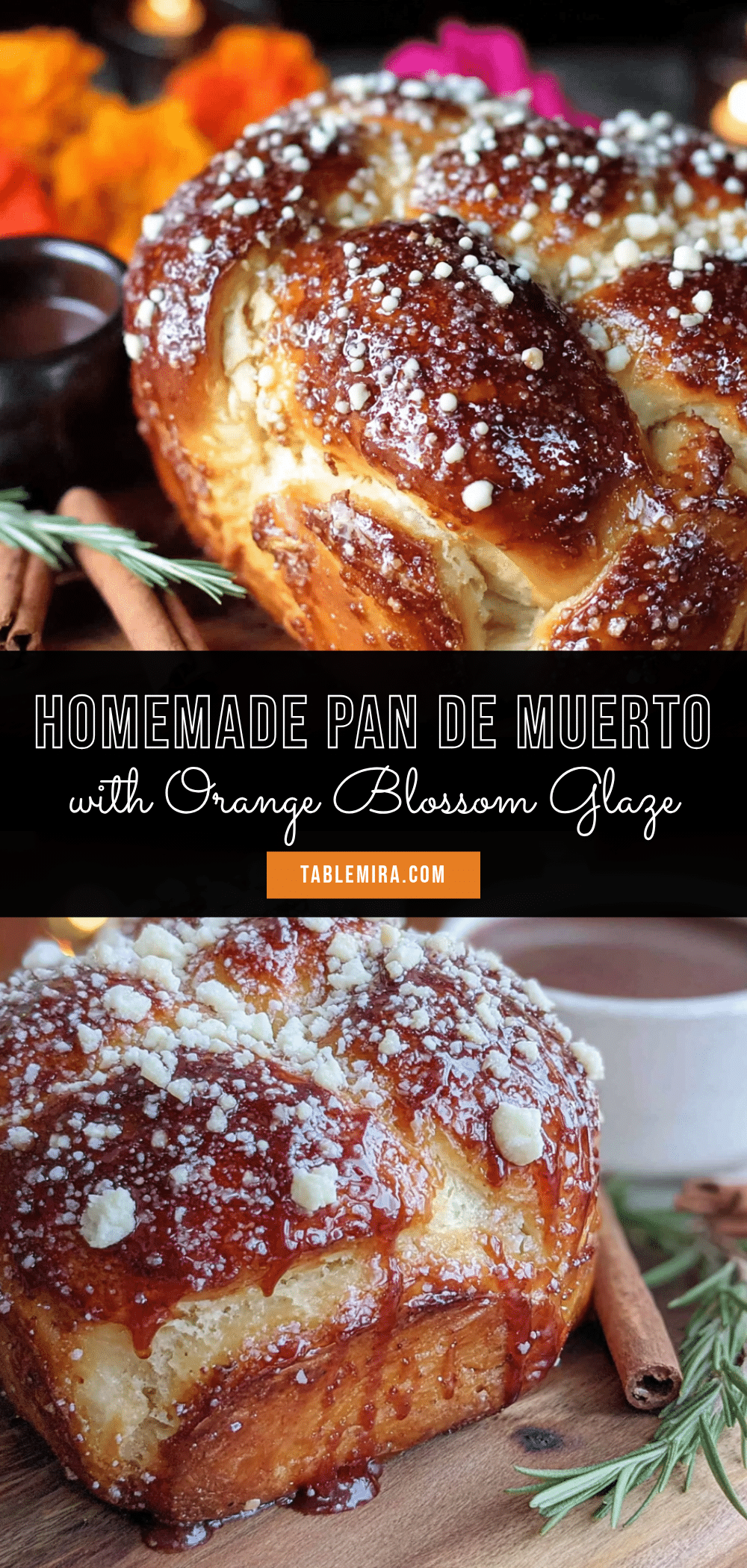
Easy Homemade Pan de Muerto Recipe with Orange Glaze
This soft, pillowy Pan de Muerto with a fragrant orange blossom glaze is the perfect bread for Día de Muertos. It’s a comforting, easy-to-follow recipe that honors tradition with simple ingredients and a tender, flavorful crumb.
- Prep Time: 30 minutes
- Cook Time: 25-30 minutes
- Total Time: 3 hours (including rising time)
- Yield: 8 servings 1x
- Category: Bread
- Cuisine: Mexican
Ingredients
- 3 tablespoons bread flour
- 1/2 cup water
- 3 1/2 cups bread flour (plus more for dusting)
- 1/4 cup granulated sugar
- 2 1/4 teaspoons active dry yeast (one packet)
- 1 teaspoon salt
- 1 teaspoon anise seed (lightly crushed)
- Zest of 2 oranges
- 1/2 cup whole milk, warm (about 110°F)
- 2 large eggs, room temperature
- 1/4 cup unsalted butter, softened
- 1 teaspoon vanilla extract
- 1 cup powdered sugar, sifted
- 2 tablespoons orange blossom water
- 1 tablespoon fresh orange juice
- Zest of 1 orange
- 1 large egg, beaten with 1 tablespoon water (egg wash)
- 2 tablespoons granulated sugar (for sprinkling)
- Optional: a few drops of orange food coloring
Instructions
- Make the Tangzhong: In a small saucepan, whisk together 3 tablespoons bread flour and 1/2 cup water until smooth. Cook over medium heat, stirring constantly, until thickened into a paste (about 2-3 minutes). Remove from heat and let cool to room temperature.
- Bloom the Yeast: In the bowl of a stand mixer, combine warm milk (about 110°F), 1 tablespoon of the sugar, and the yeast. Stir and let sit for 5-10 minutes until foamy.
- Mix the Dough: Add remaining sugar, salt, crushed anise seed, orange zest, eggs, vanilla, cooled tangzhong, and 2 cups bread flour to the yeast mixture. Mix on low speed with dough hook until combined. Add softened butter, then gradually add remaining 1 1/2 cups flour, 1/2 cup at a time. Mix on medium-low for 8-10 minutes until dough is soft, smooth, and slightly tacky.
- First Rise: Transfer dough to a lightly oiled bowl, turning once to coat. Cover with plastic wrap or a damp towel and let rise in a warm spot for 1 1/2 to 2 hours until doubled in size.
- Shape the Bread: Punch down dough and turn onto a lightly floured surface. Divide into two pieces: 2/3 for the base, 1/3 for decorations. Shape the large piece into a round ball and place on a parchment-lined baking sheet. Divide the small piece into four equal parts. Roll three into 6-inch ropes, shape like bones, and place across the top of the loaf. Roll the fourth into a small ball for the top center ‘skull’ and press gently into the center.
- Second Rise: Cover shaped loaf loosely with plastic wrap and let rise for 45 minutes to 1 hour until puffy and almost doubled.
- Bake: Preheat oven to 350°F (175°C). Brush risen loaf with egg wash, being careful not to deflate. Sprinkle generously with 2 tablespoons granulated sugar. Bake for 25-30 minutes until deep golden brown and hollow-sounding when tapped. Tent with foil if browning too fast.
- Glaze: While bread bakes, whisk together powdered sugar, orange blossom water, orange juice, and orange zest until smooth. As soon as bread comes out of the oven, brush generously with glaze while still warm. Let cool on baking sheet for 10 minutes, then transfer to a cooling rack.
Notes
The anise seed is non-negotiable for authentic flavor; crush lightly to release oils. Orange blossom water can be substituted with 2 tablespoons fresh orange juice plus 1/2 teaspoon orange extract. For best results, brush glaze on bread within 5 minutes of baking while still warm. Do not refrigerate; store at room temperature for 3-4 days or freeze for up to 2 months.
Nutrition
- Serving Size: 1/8 of loaf
- Calories: 320
- Sugar: 18
- Sodium: 280
- Fat: 8
- Saturated Fat: 4
- Carbohydrates: 54
- Fiber: 2
- Protein: 8
Keywords: Pan de Muerto, Day of the Dead bread, orange glaze, Mexican bread, Día de Muertos, homemade bread, anise bread, orange blossom